

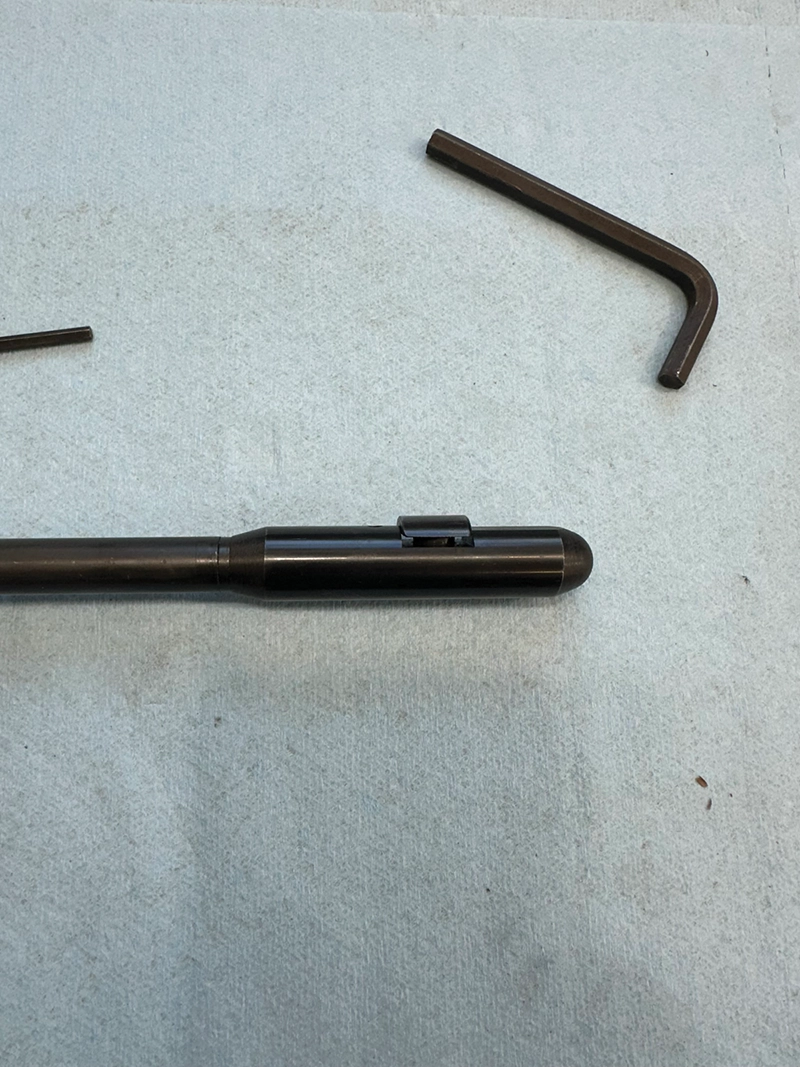
From our March/April 2026 Issue
Among the more concerning afflictions to befall a fine gun is the dented barrel. Barrel dents—and bulges, for that matter—are certainly cause for concern, as any disfigurement of a shotgun barrel can impact the travel of the shot column down the barrel, creating pressure changes that may, in the best case, impact pattern density and shot efficacy. In the worst case, extreme pressure changes resulting from damaged barrels can prove catastrophic, both for the gun and for the well-being of the person who pulls the trigger.
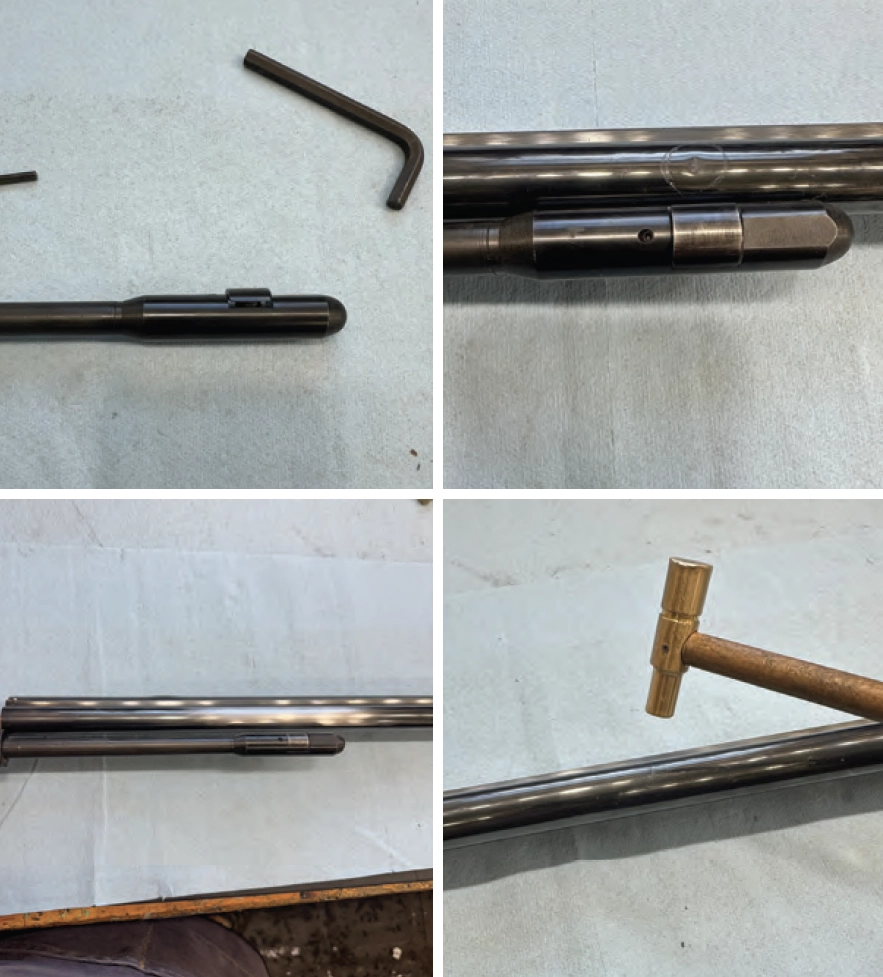
Clockwise from top left: A “dent raiser” tool shown
with its anvil extended; the dent raiser beside a
dented barrel, into which it will be inserted so that
the anvil can push out the dent; peening flat the
displaced metal after the dent has been pushed
out; the barrel after being polished and before
re-bluing (note the collar on the dent raiser that
allowed the anvil to be inserted to the proper
depth directly beneath the dent).
Yet the occasion of a dented barrel does not necessarily mean that a fine old gun is destined for the scrap heap. A qualified gunsmith and one who understands the process of raising dents and assessing the necessary resulting wall thickness can repair barrels that suffer dents and dings. Such fixes are a time-honored practice and one with which author Del Whitman is well acquainted.
In exploring barrel-dent repair—and please forgive the simplification—there is value first in defining and dissecting the two primary barrel injuries, namely bulges and dents. Bulges are just that: occasions when a section of the barrel profile is expanded out of round due to a high-pressure incident. Most often bulges are the result of a barrel obstruction that impedes the forward movement of the shot column. Encountering an obstruction, radical and localized pressure builds ahead of the shot column and, as physics dictates, something must give. Often that something is the steel of the barrel itself, as high pressure forces the steel to stretch outward, causing a bulge.
Bulges are incredibly difficult to repair, in large part because they are generally not localized but instead ring around the entirety of the barrel. Bulges are, therefore, almost always catastrophic, rendering the gun effectively unsafe to use.
Inversely, dents are caused by incidents of inward pressure on the barrel. They come in all shapes and sizes, and their causes are many. Though most dents occur from drops during cleaning, falls from truck tailgates or car hoods, tip-overs in the gun safe or dropped objects striking the barrels, they are just as likely to result when hunters suffer a fall in the field. A barrel impacted by a round or blunt object will generally be broad and elongated, while a strike on a sharp rock or similar will cause more of a crease or valley. (These two types of dents require slightly different repairs, as we will discuss.) Regardlessof the type or cause of the dent, the result is a bore that is locally caved in and brought out of round, resulting in an obstruction to the shot column’s travel. Hence, a dented barrel will cause high-pressure incidents and potential barrel blow-outs. A dented barrel should never be shot through unless it has been thoroughly examined and properly repaired.
When Del receives a dented barrel, he first thoroughly assesses the degree of damage and deformation. With a wall-thickness gauge, the barrel wall is carefully measured in the region of the dent, in essence to check the degree of existing wall thickness to which the barrel can be reduced. Each and every dent repair results in metal removal and a loss of wall thickness, and if the dent is substantial and the wall thickness minimal, the gunsmith may determine that any repair will result in a barrel wall incapable of withstanding the pressures of standard ammunition. If a repair is possible, however, special tools are assembled to put the dent back out and return the outside metal of the barrel back into place.
Specialized tools called “dent raisers” are most often employed to repair dents. These tools are most often built to accommodate 12- or 20-gauge bores, and they are somewhat hard to describe. They generally fall into two categories—hydraulic dent raisers and mechanical—and both consist of a rod that is 4" or 5" long that is attached to a cylindrical tube just smaller than the bore diameter. Inside the cylinder sits a small anvil that, when activated by hydraulic or mechanical force, pushes outward perpendicularly into the bore axis.
The process begins by inserting the dent raiser to the appropriate depth in the barrel so that the anvil is centered on the dent. An adjustable collar fitted to the rod sets that depth, and the rod is then rotated to place the anvil onto the deepest portion of the dent. A screw on the dent raiser is turned to force a piston forward that pushes the anvil outward, exacting outward pressure on the dent. As the dent is “raised,” the outside surface of the barrel is likewise raised. The gunsmith uses a nylon or brass hammer to peen flat the displaced metal around the dent, and the process is repeated. Slowly, the depression into the bore is pushed back in line with the undamaged surfaces of the bore, and the outside surface metal is tapped back until it is uniform with the rest of the barrel profile. If done too aggressively, minor cracks or fractures will form in the barrel, creating loss of integrity and potential dangers.
A few notes are required here. Steel, despite its tensile strength and hardness, is slightly elastic. When a dent occurs, the steel is stretched and the molecules composing it are rearranged. The collective push on the inside of the barrel wall and the compression of the steel created by hammering push these molecules back into place, but only so much. Once the dent raiser has done the lion’s share of repositioning the steel, there invariably will remain a minor depression or bulge on the outside barrel profile and a minor dent or reduction in concentricity dipping into the bore. Hence, once the dent is raised, the bore must be honed and polished to regain concentricity and, if warranted or desired, the outside of the barrel must be re-struck and re-blacked or -blued.
Smallbore guns such as 28s and .410s require a slightly different approach. Because most dent raisers are built to accommodate larger bores, gunsmiths repair a smallbore dent by forcing a series of ever-so-slightly tapered brass mandrels down the bore. Beginning with a mandrel that is, say, .025" less than the bore diameter, successive mandrel sizes are increased incrementally by .005", and each larger mandrel’s passage through the bore forces the dent up and out. The peening, or flattening, process on the outside of the barrel remains the same. Being that the mandrels are made of brass, they will not scratch or score the bore, but they will take a literal and figurative beating over time and must be periodically polished or replaced. The final mandrel forced down the bore will, at best, leave some depression in the bore that will have to be honed out.
Obviously, the honing process required to return the bore to concentricity and the striking process required to return the barrel profile to shape removed metal. Provided the ending barrel-wall thickness is sufficient, the gun can return to safe use, albeit with a minimally weakened spot in the repaired barrel. A final careful measure and an informed assessment of barrel-wall thickness are required by the gunsmith.
In the event of a “creased” barrel or dent that creates an acute valley, it can be hard to remove the full low spot from the outside barrel profile. In such cases metal cannot be swaged back into placeto completely eliminate the crease. Even if bore concentricity is restored and the barrel is rendered safe, there will remain an aesthetic blemish that likely will impact the gun’s resale potential.
Though all of this should instill hope in the owner of a gun whose barrel(s) has been dented, there are other considerations. Del often advises would-be buyers of old guns—namely those that, despite passing proof, are built with very thin barrel walls—to consider fragility. Such guns will be both more susceptible to barrel dents and/or bulges, and they will not have the requisite wall thickness to be repaired if damaged. All are factors worth considering.
As a parting thought, barrels are often damaged at the muzzles when they are dropped during cleaning or disassembly. The muzzle end, where the choke is, typically has more wall thickness than the rest of the barrel. A dent at the muzzle can be raised in typical fashion but, to maintain regulation and accuracy, the aperture at the muzzle has to be perfectly square to the axis of the bore. When a muzzle dent or ding is repaired, a bore-piloting crowning tool is used to cut the entire face of the muzzle flat and perpendicular again; and if the gun is a double, both barrels must be re-crowned, it will lie out of square, and as the shot column exitsw the barrel, gasses will escape unevenly, deviating the shot column and throwing off the pattern noticeably.
So there you have it. Can dented barrels be repaired? Oftentimes yes, but only by a capable gunsmith and one sufficiently concerned about wall thickness and corresponding pressures who can advise on the future safe use of the gun. Better yet, as Del can attest, it is best ot prevent dents altogether. Though accidents can happen, an ounce of prevention is worth a ton of cure.
Read our Newsletter
Stay connected to the best of wingshooting & fine guns with additional free content, special offers and promotions.