
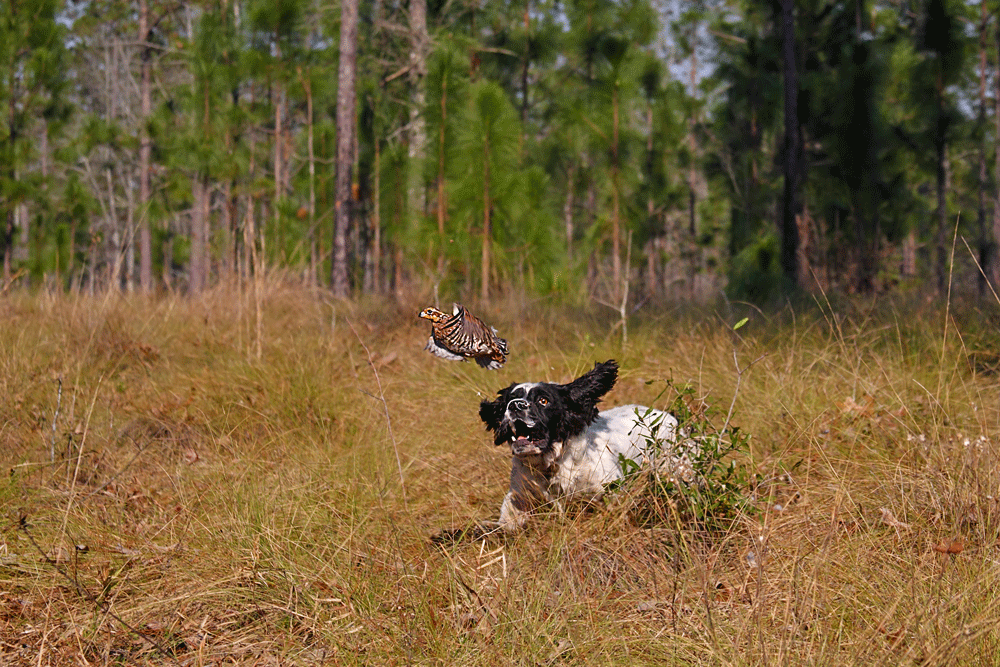
One low bird. One poor decision by a hunter. One bird dog about to be shot. Cody Alford watched it all happen in slow motion when a quail flushed left and low during the covey rise on a guided hunt. "Low bird! Low bird!" Alford yelled, doing his job as an Alabama guide. Somehow, with all the excitement, the hunter didn't hear Alford or couldn't heed the warning. "When the bird got on top of Emma's face, he pulled the trigger," Alford said. "Boom."
Emma, Alford's five-year-old English setter, took more than 50 BBs in the head from a .410 shotgun. "The wad was melted in her ear," Alford said. "But somehow, some way, Emma was still alive!" Alford loaded his injured setter into the Jeep and sped to the closest veterinary clinic in town. "Fortunately, the vet got Emma stable," Alford said, "which was good news. Then he gave me the bad news: 'She's going to be permanently blind in both eyes.'"
Emma lived five more years and even hunted again, with Alford using planted birds in a clean field. "She couldn't see, but she could still find birds with that nose."
Because at the time Emma was the best bird dog Alford had ever owned, the guide wanted a puppy out of her. "I didn't know if you should or could breed a blind dog. The vet said it would be OK."
Emma produced a litter, and Alford kept three puppies—Ember, Ella and Eli. Eli was by far the best. Sadly, just three years later Eli paid the price for another poor decision by a hunter, only this time Eli did not survive. According to Alford: "Our hunters shot three birds on the covey rise, and we were in the process of picking up the birds. Eli was going for the one on the right when he bumped another bird."
That's when a client whirled and fired. "Eli was shot in the hind leg and came running back to me. He went limp in my arms. We never had a chance to go to the vet."
Dr. Clair Maples is in the business of helping clients make good decisions in the field, especially when it comes to emergency first aid and keeping sporting dogs safe and sound. She's a veterinarian, a hunter, an occasional guide and the proud owner of three German shorthaired pointers. Dr. Maples also is the founder and owner of Paradigm Sporting Dog, which specializes in first-aid kits with essential items to help dog owners and handlers care for injured dogs in the field or back at the truck.
Dr. Maples has never had any of her dogs shot, but she would know what to do if that worst-case scenario happened. She said surviving a gunshot wound often depends on administering first aid in the field that buys time before getting back to the truck or to a vet clinic.
"A lot of times the prognosis depends on where the dog is wounded," Dr. Maples said. "Is it the leg, the head or the body? And was the injury sustained at close range? With gunshot wounds, hemorrhaging and trauma—like a penetrating wound in the chest or abdominal cavity—are major concerns. The first few minutes in the field and the next 24 hours are critical."
Maples said the gut-wrenching effect of seeing your dog injured and bleeding can be overwhelming for many people. "That's the first phase of triage and what we call the emotional response," she said. "It's really important to quickly move to the decision-making phase that creates action. Being unprepared or unable to move beyond the emotional phase can affect your dog's outcome."
That's why it pays to have a plan—and a first-aid kit in your vest or pack. The simple latex tourniquet found in Dr. Maples' first-aid kit can be a lifesaver for a dog hemorrhaging from a gunshot wound to the leg. "The only way you're going to control blood loss, or achieve hemostasis, is by covering the wound and applying pressure, using clotting agents like hemostatic dressings or applying a tourniquet if you still can't stop the bleeding.
"A technique I teach my clients when using a basic latex tourniquet is to wrap twice above the injured area, then clamp the ends of the tourniquet close to the leg with a hemostat. That way all you need to do is unclamp the hemostat to remove the tourniquet."
Tourniquets can be tricky. "Tourniquets can stay on for 30 to 45 minutes before you start to risk a perfusion injury and tissue damage from prolonged use. However, if you take the tourniquet off and the wound is still severely hemorrhaging, the tourniquet needs to go back on and stay on until the veterinarian can take it off. If that tourniquet needs to stay on for a long time, you might need to be OK with a three-legged dog over a dead dog."
If a tourniquet and hemostat are not in your kit, Dr. Maples encourages people to get creative in the field—and fast. "You can use a slip lead, a belt, a watchband or even a woman's hair tie as an emergency tourniquet. I mean you have to be innovative!"
Penetrating wounds to the chest or abdominal cavity can present even more challenges. "When a BB penetrates the chest cavity," Dr. Maples said, "the dog can suffer a pneumothorax, which is air in the chest cavity between the chest wall and lungs that can cause lung collapse. Air can enter the chest cavity from the outside through a wound or on the inside from a damaged lung lobe. Sometimes you can see external wounds into the chest cavity bubbling blood in association with the dog's respirations, creating a back-and-forth airflow. It's like watching soapy water on a tire to find the leak. You can attempt to treat an active pneumothorax in the field by creating a poor man's chest seal with a small plastic baggie, some lube or petroleum jelly, and Elastikon tape. Put a blob of lube on the bubbling area, press the plastic baggie over it smoothly, and tape the baggie to the dog."
Dr. Maples cautions against going straight to applying a chest seal unless the wound is bubbling or there's a pathway from the outside environment into the chest. And the chest seal is a temporary fix until you can get the dog to a clinic. Makeshift chest seals also must be "burped," or temporarily lifted, to allow the release of pressure within the chest cavity after being applied.
"Also, one thing you should never do is wrap a bandage around the whole dog after applying the chest seal," she said. "The dog is going to be in shock and experiencing difficulty breathing, which you could worsen by applying a tight full-body chest bandage."
Other potentially life-threatening injuries from gunshot wounds include internal hemorrhaging, such as accumulation of blood in the chest cavity (hemothorax) or abdomen (hemoabdomen). "Sometimes the point of penetration is not bleeding," Dr. Maples said. "Sporting dogs are tough, resilient and good at masking injuries. No matter how great your dog looks, if it's been shot or even peppered from a distance, you need to take that dog to the veterinarian for an exam and possible X-rays to assess for worse damages."
Dr. Maples adds that a dog that's been shot or injured will likely be in a state of shock. "That's when the dog's body is trying to survive whatever situation it's been put in by shutting down some systems and prioritizing others. In our hunting dogs, you're going to see a low body temperature—something less than 98 degrees Fahrenheit. That dog is going to need warming support. When assessing for shock, one of the first things I recommend is checking the gums. Know what normal gum color is for your dog. That's usually a nice pink color. A dog in shock will have pale, almost-white-looking gums. There's also going to be an increased heart rate with a weak pulse."
Dr. Maples said a dog in shock needs to get to the veterinarian as soon as possible. "In the meantime," she said, "try to keep the dog calm and warm. Shock is an emergency no matter the reason. The dog is probably going to need IV fluids and cardiac-resuscitating drugs and other meds and tools that the layperson is not going to have."
Dr. Maples said a first-aid kit should have basic tools—many of which can be applied in case of a gunshot wound. A space blanket can help keep dogs warm; a muzzle may be necessary, because dogs in pain may bite. A tourniquet or two, of course, as well as a hemostat for hemorrhaging and gauze, vet wrap and tape. She's considering adding a hemostatic dressing to the Paradigm Sporting Dog kit for more-traumatic hemorrhage situations. The product is a collagen-based gauze that forms a gel-like plug when it comes in contact with blood.
Of course, an ounce of prevention is worth a pound of cure. If you're lucky enough to hunt with Dr. Maples and her GSPs, she's going to make firearms safety a priority. "I've guided groups and everybody was great," she said. "But I have no shame telling a grown man to keep his gun barrel up. If you listen to most people who talk about their dogs getting shot, most of those injuries and accidents happen because people are walking along and pointing their gun barrel at the ground. When they go to shoulder the gun, the barrel lines up with the dog at some point. Maybe they pull the trigger early. Maybe they take a low shot. If that barrel is pointed up and in a safe direction, you're way less likely to have an accident."
Read our Newsletter
Stay connected to the best of wingshooting & fine guns with additional free content, special offers and promotions.



I found this article very disturbing. There is no excuse for shooting a dog while hunting. I have hunted many time with guides and their dogs. I always start a bird hunt with fellow hunters that I know and those that maybe new to a group; “Do not shoot -pull the trigger if a dog ends up in your site picture!!!!”. This is part of the most fundamental rules of hunting and “safety first” in the field. If you cannot follow this rule and other important safety rules you should not have a shotgun in your hands. I applaud those lodges and bird hunting facilities that place a hefty price tag for shooting a dog while hunting..
Never shoot below the bill of your hat.