

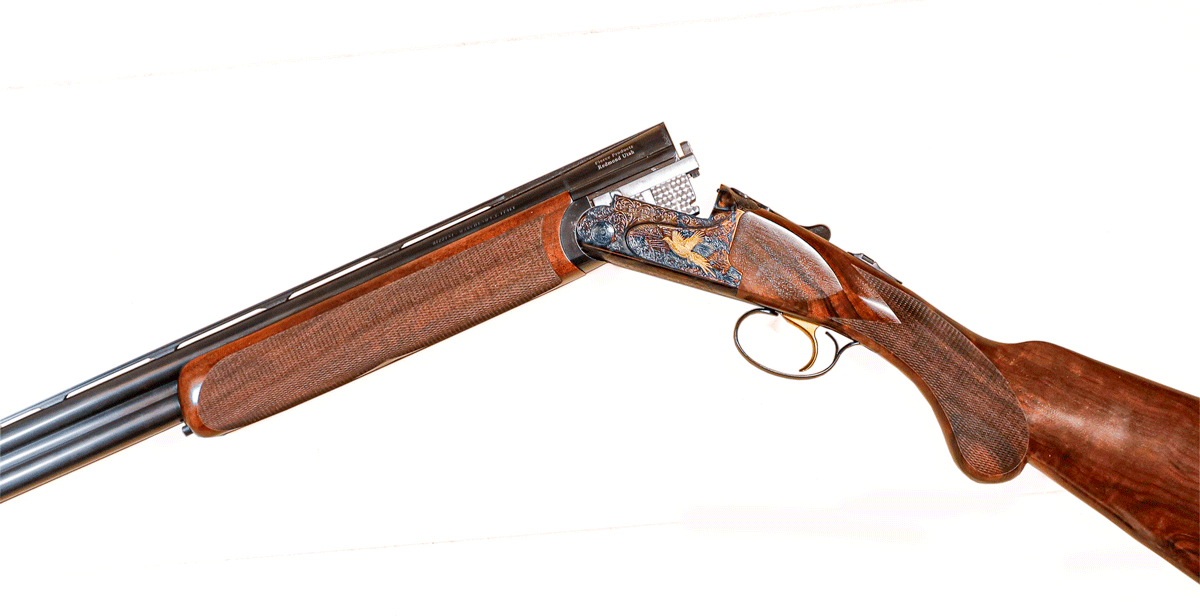
Battista Rizzini shotguns are all around me in the Orvis Sandanona gunroom. Consigned BR110 Sporters arrive, and their tenure on the rack is fleeting. The same is true for BR110 Light Luxe models. A dandy Premier Sporting 20-gauge in-house now would serve well in the field. I reviewed a splendid BR460 12-gauge Sporting in the May/June 2024 issue, so I was jazzed about reviewing another Rizzini: an Aurum Evo Classic 20-gauge over/under with 28" barrels. (The model also is available in 12, 16, 20 and 28 gauge as well as .410 with 28" and 30" barrels.) Its list price of $3,950 makes it a worthy investment in a solid field gun.
The Aurum Evo's 28" chromium-molybdenum steel barrels were well crafted. They are deep drilled and steel safe with a stunning black-and-muted-gloss finish. The muzzles were crisp with no gaps or excess solder at the rib end plugs. The ventilated parallel 5mm rib is machine filed and finished with a brass bead. Mid-ribs run from the muzzles to the monoblock. The jointures were flawless. The top barrel's seam at the monoblock was camouflaged with a touch of floral engraving. The seam for the bottom barrel was visible but perfect. There was one notable anomaly: blemishes on the sides of the top rib and rib posts. I eventually determined that they were due to a lack of attention in surface preparation prior to bluing.
The monoblock is engine turned on the sides and blued underneath. The cuts for the hooks, lugs and bifurcated bite were fantastic. The ejectors were well executed, with a tight fit in the milled ejector channels. During test firing, the properly timed ejectors were beastly, tossing shells a good six feet.
The monoblock's 3" chambers transition to +/- 1" forcing cones. Short forcing cones are the norm for Rizzini field barrels. Longer forcing cones are reserved for the company's competition guns. The barrels are overbored at .629" (nominal is .615"). Five 2¾" nickel-plated flush chokes threaded in and out smoothly and seated 1/32" below the muzzle. There are wrench cutouts, and notches indicate constrictions. The constrictions are also etched on the shafts—although the Full choke is merely notched. Measurement-wise, the Cylinder and Improved Cylinder chokes were spot-on nominal, and the Modified was slightly tighter than nominal. The Improved Modified measured closer to Full, and the Full choke measured more like Extra Full. The included blued-steel wrench is a winner.
The action has smooth edges and carries comfortably in the hand. I am a case-color snob, and Rizzini gets it right with an alluring salad of intermingled purple, bronze, blue and brown. My only quibble is that the protective clear coat is too glossy. That slight criticism notwithstanding, the rest of the action is compelling. Pronounced bolsters are adorned with game scenes punctuated by a gold pheasant on one side and quail on the other. The engraving is not deep relief, but the sufficient contrast leaves no mystery as to what lies beneath the colors. The top and bottom are decorated with botanical scroll, "Rizzini" appears in small banners on both sides, and "Aurum Evo" is in a shield underneath.
Parallel cooking bars were well fit in the well. The other surfaces had precise cuts and smooth finishes. I saw no machining marks, swirls or burrs at the knuckle, deep in the well or on the face. Lesser manufacturers may rely on colors to obfuscate tooling marks; Rizzini does not. There is a quality of surface preparation and execution here that I would expect on far-more-expensive guns.
The lock-up is familiar. The barrels pivot on stout replaceable pins at the knuckle. Two lugs on the monoblock engage deep cutouts in the well. A broad underbolt emerges from the bottom of the action to engage a bifurcated bite in the monoblock. This solid system presents nothing new or innovative, because it is simply not warranted.
The blued toplever is stippled on both sides, which lends aesthetic balance. The integrated safety and barrel selector were smooth and positive. The safety is stippled, and the barrel selector is serrated. The attention to detail here results in a mechanism that does not fight the shooter. A plain blued trigger guard surrounds a fixed gold-blade trigger. After a mere suggestion of take-up and zero creep, the crisp breaks of 3½ and 3 pounds were quite pleasant.
The frame's internal surfaces were free of unsightly tooling marks. The cast lifter, inertia block and barrel selector had a rough finish, but a less-than-comely appearance here does not impede function. A bifurcated safety spring is secured at the top. The rear post anchors parallel coil springs that run along the bottom. Forged blue hammers pivot from the bottom, and forged case-colored sears pivot from the top. Firing pins sit in the front. The surfaces on these mission-critical parts were glassy and precise, with no burrs or irregularities. Rizzini has not broken any new ground here but, as with the lock-up, the system works.
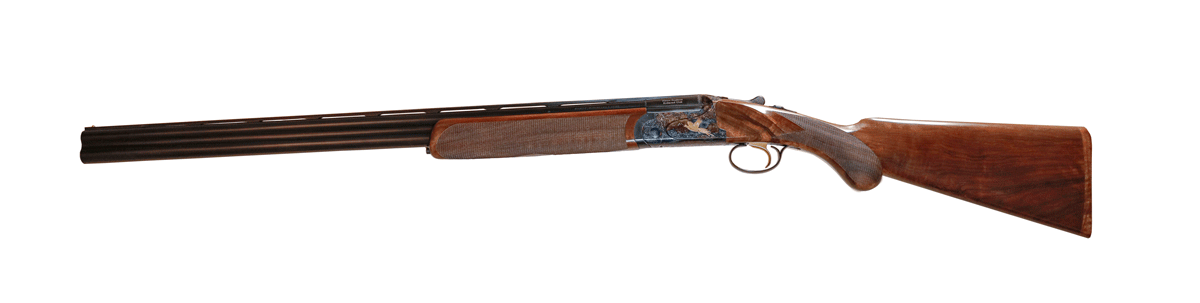
The dark Turkish-walnut stock featured horizontal waves of understated figure. Some darker burls spiced up an otherwise prosaic piece of wood. The low-gloss oil finish filled the pores and grain and had been applied liberally to the interior of the ears but was missing in the deepest recesses. The 26-lines-per-inch checkering with rounded diamond tops had crisp borders and was agreeable to the touch. The rounded half-pistol grip is a masterstroke. Normally I am not a fan of such grips, but on the Aurum Evo the gentle slope and ethereal wrist approach the qualities of an English stock with an enticing reach to the trigger. The well-fit wood buttplate had horizontal cuts in the middle and a smooth heel and toe. The smooth heel facilitated the gun mount.
The wood-to-metal fit was perfect around the top tang but too proud at the head. At least it was uniform on each side. The fit at the rear of the trigger guard was recessed a healthy ¼" beneath the stock. The gap was noticeable across the middle finger. With a glove on it might not be an issue, but bare handed it was annoying. The stock measurements were: 14½" length of pull, 1½" drop at comb, 2½" drop at heel, ¼" cast-off and 4° pitch.
The trim forend was as agreeable as the grip. It had near-full-coverage checkering with clean borders and a superb oil finish. A cool blued diamond escutcheon decorates the bottom and is bordered by a larger unchecked diamond. The iron's inletting and fit were exceptional, and the blued knuckle hook fit seamlessly to the wood. The pushbutton release operated effortlessly but with sufficient spring tension to keep everything in place. I harp on ease of attachment and detachment, because it matters. Assembly and disassembly should never be a chore.
At 6⅛ pounds, the Aurum Evo Classic came in right at factory specs. I am spoiled by a 5¾-pound Beretta 20-gauge as my primary bird gun, but I have grown accustomed to reviewing and carrying contemporary field guns that weigh more. The gun balanced at the knuckle and felt heavier up front with a preponderance of mass under the forearm. This sensation was no detriment to performance or handling.
Shooting Winchester Super Target 2¾" ⅞-oz loads of No. 8s at 1,200 fps, the barrels patterned 60/40 through IC & M chokes with spot-on convergence. A few rounds of stouter Browning ammo mimicked those results. Recoil was somewhat sharp, as would be expected with a wood butt and light gun.
Given that chasing clays is an ersatz substitute for a proper field hunt, I spent only a short time at the 5 Stand with some Orvis peers. The accolades were universal. Everyone agreed that the Aurum Evo was lively, nimble, quick to the face and super pointable. The smooth swing allowed for moving effortlessly to targets on true pairs. On one crosser paired with a rising straightaway, I could not miss. A member of the group snuck off with the gun for a round of Helice and fell in love, confirming my observations about the weight distribution. The Aurum Evo's stock warranted the greatest praise. A novice in the group exclaimed, "I love that grip, and the forearm is really sweet." These were not comments I expected from someone who had not handled a lot of guns, but the Aurum Evo spoke to him.
A few days later I enjoyed a field hunt for pheasant and chukar with a friend and his son. I had every intention of switching to my Beretta at some point, but I enjoyed carrying the Aurum Evo so much that I never did. Snap shots at wild-flushing birds, well-set-up presentations over hard points, and swift crossers through the trees were all taken with aplomb. I tend to drag on birds in the field, and the Aurum Evo allowed me to catch up with second shots without being whippy. The swing was even and effortless, and I was grateful for the second barrel with the tighter choke. Oh, and being kitted out in hunting gear, I found the recoil negligible.
The Aurum Evo Classic is a well-built entry-level field gun. And "entry level" is not an invective. For me, entry level is the proper starting point for a well-made Italian gun. A shotgun like the Aurum Evo is hardly an heirloom piece, but it is an impressive production gun with a nod to durability and a good dose of style that will withstand a lifetime of hunting and clay breaking. Buying an Aurum Evo Classic is buying a legacy, not a regret.
For more information, visit rizziniusa.com.
Greg Carpiniello is the Gun Department Manager for The Orvis Company. His home base is the Orvis Sandanona Shooting Grounds, in Millbrook, New York. When he's not selling guns, he can be found chasing woodcock.
Read our Newsletter
Stay connected to the best of wingshooting & fine guns with additional free content, special offers and promotions.