

From our January/February 2026 Issue
There has always been an inherent self-confidence in Scottish gunmaking. It comes from the quiet knowledge of a higher standard. Under the stewardship of new owner Grant Buchan, that remains as true today at McKay Brown Gunmakers as it ever has.
At the zenith of gunmaking in the decades before and after the turn of the 20th Century, Scotland’s gunmakers were building guns for Scottish industrialists, bankers and landowners. These patrons had no need to look south to London for fine-quality firearms. Indeed, while many of their fortunes hinged on the expanding British Empire, they were fiercely proud of homegrown Scottish industrial output. They led the world in shipbuilding, textiles and banking, and many did not want a London sidelock coming out of their slip in a grouse butt.
The McKay Brown triggerplate round-action—both side-by-side and over/under—is rooted in the designs of James MacNaughton and John Dickson. These were among the finest guns ever designed and built. It is a testament to the brilliance of the original design that the triggerplate model has been adopted by gunmakers around the world seeking the ultimate in balance and handling. With the working parts of the mechanism located on the triggerplate beneath the action rather than in lockplates on the sides, the gun’s handling is fundamentally improved. The center of gravity is lowered and brought more centrally between the hands. This is akin to tuning the chassis of a race car. For those who shoot some of the fastest gamebirds in the world, such handling is crucial. A properly fitted, correctly balanced shotgun is the key to unlocking the hand-eye coordination vital to good shooting.
Some mistake the round-action side-by-side for a boxlock, but this is a common misconception typically made by those relatively new to the sport or unfamiliar with fine firearms. Yet it is precisely such misunderstandings that can point to a higher level of appreciation for what we should be seeking in fine gunmaking. Some shooters buy guns merely to keep up with their neighbors—to mark themselves out as affluent and able to afford such luxuries. This is often influenced by the amount of external embellishment on a gun. Simply put, London-pattern sidelocks offer more surface area for engravers to apply their art than Scottish round-actions do. But those with more-nuanced understanding of the differences between a good gun and a best gun are less distracted by appearances.
After apprenticeships with both Alex Martin, in Glasgow, and John Dickson & Son, in Edinburgh, McKay Brown’s eponymous founder, David McKay brown, built his first side-by-side round-action in 1974 in a small workshop just outside of Glasgow. There he quickly established a reputation for building best guns using the round-action design. He produced his first over/under round-action in 1992 as the game-shooting market moved in that direction.
After more than 60 years in the trade, McKay Brown started thinking about retiring, but he wanted the thread of Scottish gunmaking DNA to be passed on. It was taken up by Grant Buchan. In truth, Buchan already had been holding his own thread as a maker of highest-quality guns for more than two decades under the name Buchan Guns. Having worked alongside some of the world’s best gunmakers in Val Trompia, Italy, during that time, he had had the privilege of walking through doors that most of us would not even know how to find.

With the acquisition of McKay Brown in 2021, Buchan has been able to blend centuries of gunmaking excellence with the brilliance of Scottish design, applying modern processes from all over the world to take the brand into a new century.
In glorious May sunshine I meet Buchan outside his workshop near Peterhead, on the easternmost part of mainland Scotland. This is the machine shop—the heart of the matter where the parts are made. The parts then go to a facility in Kilmarnock, where the gunmaking team builds locks and does the jointing and assembly. A functioning barreled action “in the white” then comes back for regulation of extraction and lock timing. It then goes to a workshop next to Buchan’s house where further fine-tuning takes place and it is stocked. After stocking and test-firing, the gun is polished and prepared for engraving. Part of the engraving team is based in Edinburgh, but for specific commissions guns may be shipped to individual engravers in Europe. When back from the engraver, the gun is hardened and blacked and then finished to the highest standard.
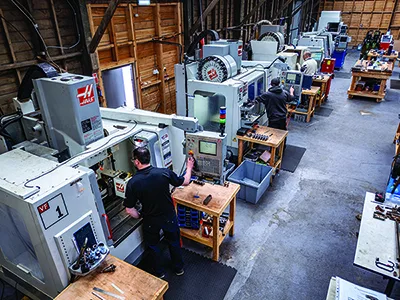
It is rare to spend time with the owner of a gunmaking firm who not only possesses a broad understanding of the brand’s place in the world of gunmaking but also can take his place at any of the workstations in his factory and operate all the machinery.
As we begin to discuss the changes and improvements to the design of the McKay Brown round-action, Buchan breaks off to check on the health of one of his employees. His is a small, dedicated team of 14, and it becomes clear that the old way of operating in gunmaking—with highly specialized individuals—is out. Instead, Buchan wants his gunamekrs to have all-around skills. This ensures not only the continuity of production but also keeps his team fresh and motivated. He hires gunmakers who share his vision for adaptability, assessing that the more an employee understands the whole process, the better the gun will be.
This is the pursuit of excellence rather than perfection. The team is always thinking, discussing and looking for options to improve. With an already highly regarded design, the first stage after Buchan took over was to consolidate the production process. The technical drawings were painstakingly turned into CAD, so the latest equipment could be employed. All the manufacturing of parts was brought back to Scotland from outworkers in England. This was to ensure a level of quality, not as part of a marketing exercise. As Buchan and I get further into the discussion of fine gunmaking, it becomes clear that nothing is window dressing, there are no salesmen. When you order a gun from McKay Brown, you deal with Buchan himself.
A clear example of the quest for betterment is the fins between the forend wood and the metal on either side of McKay Brown’s over/under barrels. Previously, as the barrels heated with heavy use, the fins occasionally would loosen. This was a known issue with the old design. Now as part of the culture of continual improvement, the fin is one piece rather than two. It is far more complex to make, polish and fit exactly, but it solves the issue. Buchan demonstrates this for me, sliding the perfect tong-like part from the muzzles down the barrels to slot satisfyingly home.
“We really do go to town on detail,” Buchan says, “but we think that detail is what our clients are looking to us for.”

This also applies to changes in ammunition. Our discussion inevitably moves to non-lead shot, as the UK game-shooting sector has been moving in that legislative direction.
“We have a nominal bore length of eight inches, and that’s it,” Buchan says. After that, the choke profile begins. This gradual profile means that, unlike the barrels of many other makers, McKay Brown barrels go through High Performance Steel proof with 40 thou (Full) and 45 thou (Extra Full) choke—if the client requests this.
The change in the regulatory landscape of British game shooting means a higher degree of insight is needed to build guns fir for the future. At McKay Brown, Buchan’s years of international experience are being brought to bear in the process of barrelmaking. The received wisdom that chopper-lump barrels are inherently better does not necessarily apply in a world of steel proof. For guns built with purely lead-shot use in mind—particularly side-by-sides—the company still opts for chopper-lump barrels. But for the increase in pressure involved in using steel shot effectively, Buchan believes that monoblock barrels are stronger. Offering the two options may be more costly and it may increase the level of knowledge required by the gunmakers to get the best out of both, but this is clearly a company that strives to give the best possible service to its clients and their style of shooting. Each McKay Brown client has specific requests, and all can be accommodated. And in the process, McKay Brown’s gunmakers are themselves evolving.
The same applies to barrel honing. Great care was taken to source a machine that hones barrels with micron-level precision. Unlike machines used by the majority of gunmakers—operating in the horizontal plane—this machine hones in the vertical plane. “The bore is dead true,” Buchan says. His explanation makes perfect sense: “[Horizontally] the fluid is all on one side and you don’t get perfect concentric barrels. If you can keep it vertical, it’s always going to be better.”
Even though McKay Brown is making the very best guns it can, there is no perfect “all-rounder.” “We are very fortunate that a lot of our clients can afford more than one of our guns,” Buchan says. “People do ask me, ‘Can you make a gun that will do this discipline and that discipline and the other?’ The short answer is, ‘No.’ You can’t have a short-barreled quail gun that’s lightweight, a joy to carry, and wide-open choked that’s going to suit every other style of hunting. Think what you are mostly hunting, and we can make a damn good gun for that.”

In almost a homage to past gunmakers who made their own tools, Buchan explains that to use spark-erosion machinery to do the old work of chisels, his gunmakers have to make their own contact parts. Only then are they able to craft the idiosyncratic shape that forms the rear part of a McKay Brown action body. Like a lot of what the company does, it would be far simpler and cheaper to buy in these parts—but that is not an option.
“When a lot of firms change hands,” Buchan says, “it’s a case of How do we reduce costs and improve profit? We will not make a lesser product, which is why the order time is 18 months.” As he is not beholden to shareholders or a board of directors, Buchan is able to maintain the standard he requires. “We want the best,” he says. “We want to be regarded as the Fabbrì of Scotland.
“If you look down a lot of modern actions, you will see a lot of rounded surfaces. They are far easier to make. All our internal surfaces are crisp, square and precise. Someone in the future will look at our actions and say, ‘They did it right.’” There is a sense that Buchan has instilled in his gunmakers the thinking that they are not just making guns for the clients in front of them. They are building guns to honor those gunmakers who have gone before and to hold their heads metaphorically high in front of those who will come long after.
“Gunmaking is not glamorous in my mind,” Buchan says. “What’s glamorous is the finished product.”
And the finished product certainly is that. It is like little else you will find in the panoply of gunmaking. Raised engraving of thistles (a new house style) is achieved using a special technique. With the carved background offsetting and complementing the raised areas, it certainly caught the attention of one of the best-known names in the trade when it was launched at the Dallas Safari Club Convention a couple of years ago—so much so that he ordered a pair in 20-bore.
“Plumage guns” have also become something of a signature of this part of Scottish gunmaking. Man has honored his quarry since he first sat by the fire and carved a rudimentary mammoth into the hilt of a spear. This engraving pattern is the apotheosis of that millennia-old tradition, with the feathers and body parts of chosen gamebirds augmenting parts of the gun. One gun I saw featured pheasant body feathers wrapping the action, a tailfeather decorating the trigger guard and tang, and a pheasant’s head and beak forming the toplever. It is almost avant-garde in style and may not be to the taste of those who prefer traditional rose & scroll, but one cannot help admiring the quality and creativity of the design and execution.
In bespoke gunmaking at this level, all tastes can be catered to. Other examples include bar-in-wood round-actions in all the normal gauges, sidelocks built on highest-quality historic actions and finished in a Celtic style, and even new 32-bore over/unders.
Gunmaking throughout history has been in a state of evolution. As improved materials and methods come onto the scene, they replace those that become outdated. The team at McKay Brown maintains its fitness for the future by constantly experimenting and developing what it does and how it is done. Infused with longevity that comes from a culture of excellence at every stage, the guns build character over time—but the team is also acutely aware of the inextricable link with the land on which the guns are used. Not only do McKay Brown guns pay homage to the birds hunted with them, but there is also a satisfaction in knowing that many of the clients who order them are helping fund the preservation of the landscape for the next generation. This awareness of their place in the historic thread of gunmakiung and hunting—and the need to build the best guns they can—permeates everything the gunmakers at McKay Brown do.
For more information, visit mckaybrown.com.
Read our Newsletter
Stay connected to the best of wingshooting & fine guns with additional free content, special offers and promotions.


