From our March/April 2026 Issue
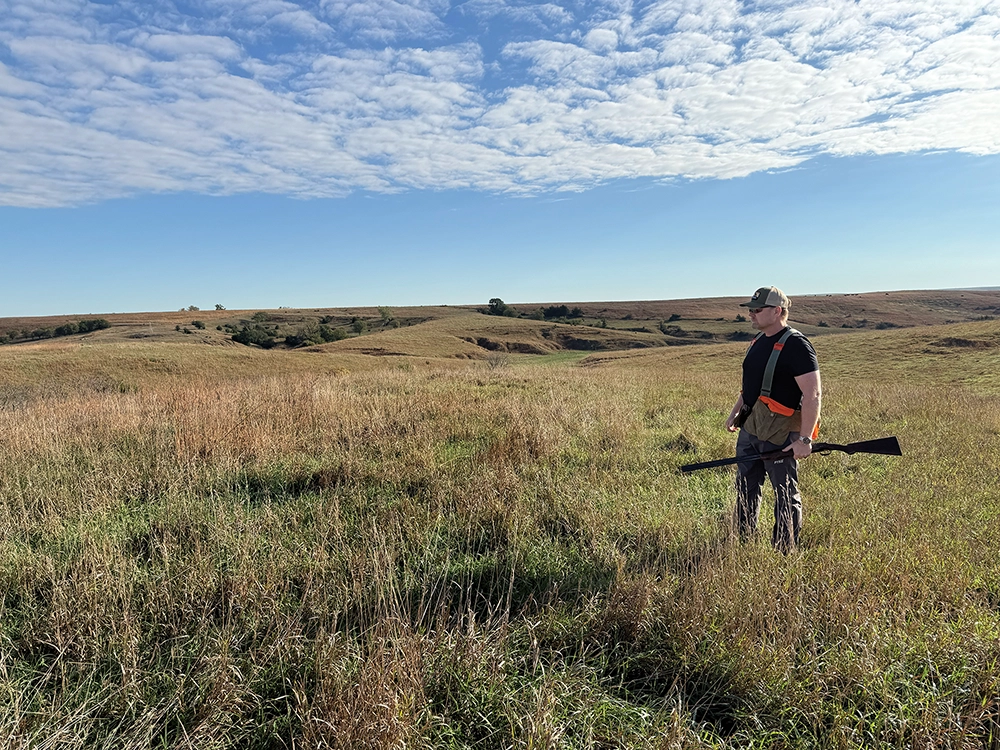
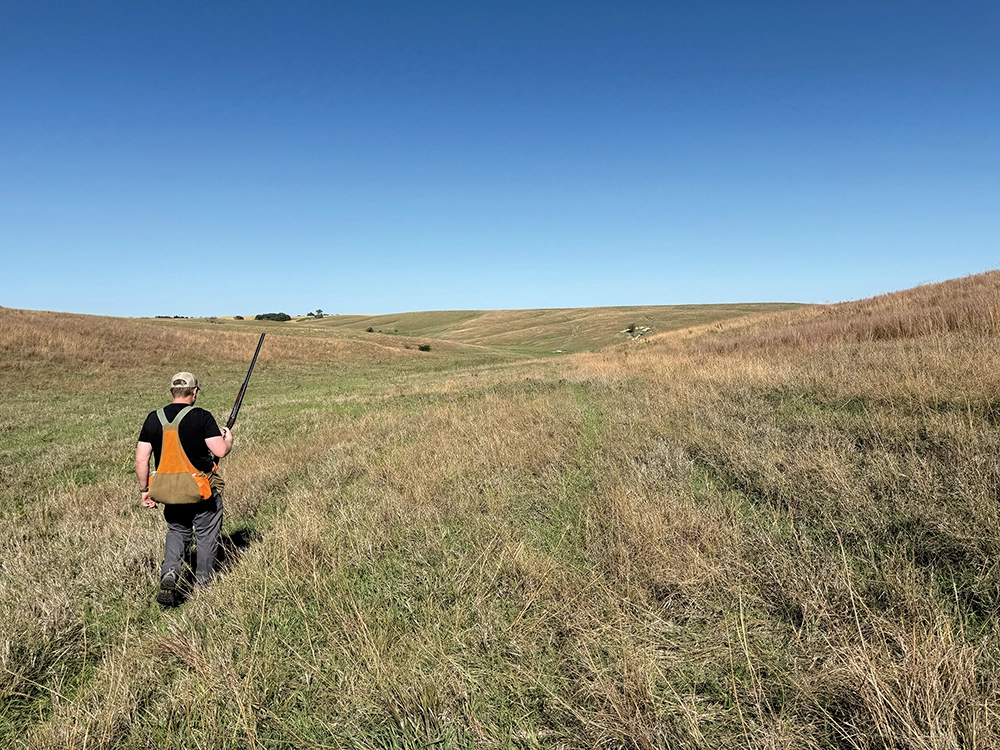
As I brisky climbed another Nebraska hill, with shorthair Zeus on point and guide Chris Colfack waving me forward like an impatient coach hurrying a two-minute drill, I tightened the grip on my over/under and resolutely quickened my pace. And yet this was not my first hill on this seasonably warm October afternoon. While my soul was mostly willing and my legs holding, I considered that there might be a limit in my 57-year-old, statin-benefitted heart. My mind was working almost as fast as my legs. And as I neared the crest of the hill—where the dog and hopefully the birds were holding—my overactive mind took over: If the value of greater prairie chickens were measured in miles traveled, these fowl would be America’s wagyu beef. It was a curious thought, but not one conducive to knocking down a wind-aided, two-pound bird with a tightly choked shotgun and a pounding heart . . . .
And so I partook in the time-honored tradition of chasing greater prairie chickens—birds that are, in fact, not chickens at all but grouse. It was 19th Century European settlers who gave Tympanuchus cupido the incorrect and unofficial name when they observed the bird’s size, eating habits, mild taste and useful substitution for domesticated chickens. At the time, the birds filled the sky, feasting on infestations of grasshoppers and supported by seemingly endless prairies. Like too many species on America’s Great Plains, however, they soon were hunted nearly to oblivion, narrowly avoiding the fate of the now-extinct Eastern subspecies, the heath hen, as market demand for the birds outstripped the species’ ability to reproduce. By the mid-19th Century, crates of birds were being loaded onto railcars bound for distant markets while magazines like Forest and Stream and American Field were incorrectly referencing the birds as “prairie chickens.” What followed was another upland version of the tragedy of the commons, as settlers and hunters feasted on the abundant birds and jeopardized their survival.
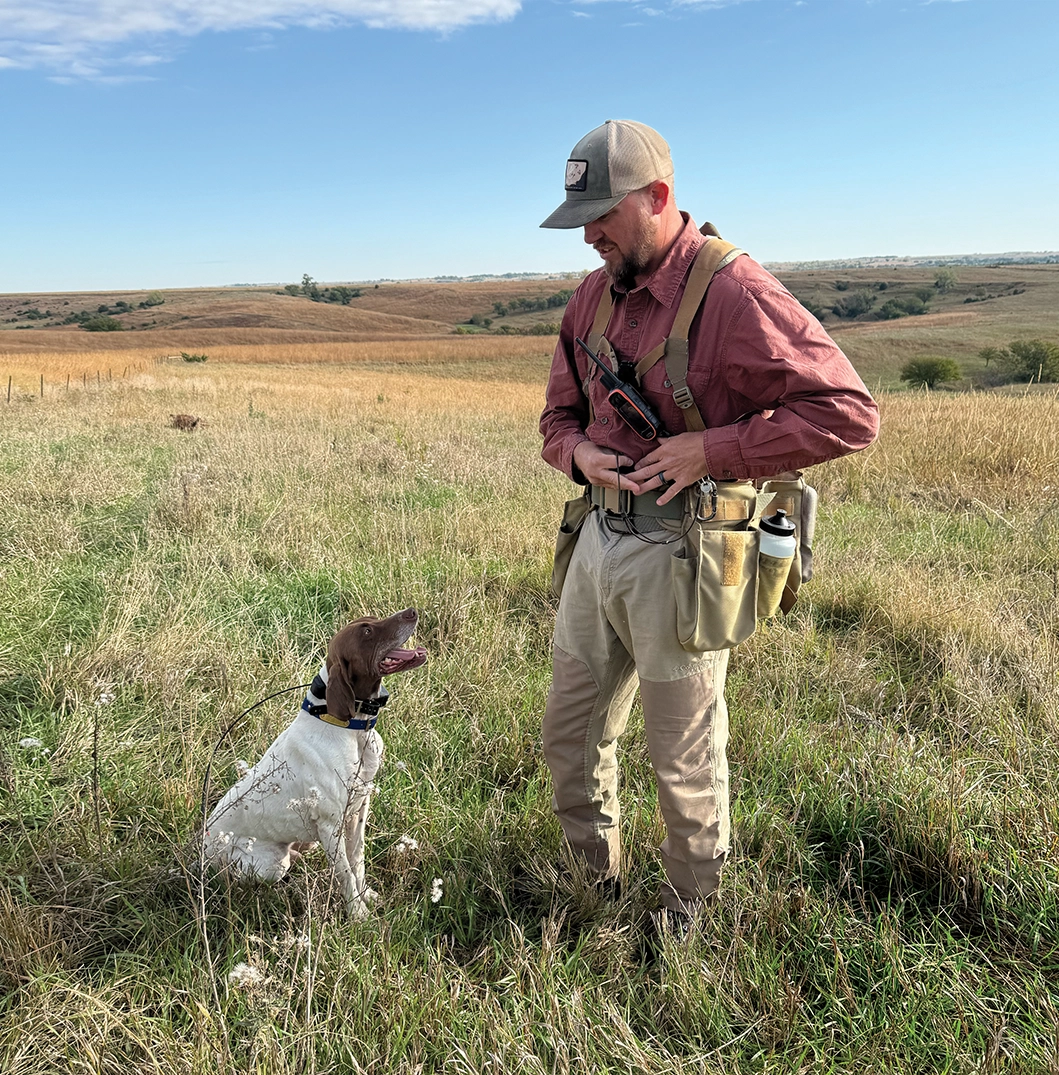
With such a tragic history, it’s fair to ask whether I should have been trudging up that Nebraska hill in the first place, let alone comparing prairie grouse to Japanese beef costing upward of $200 per pound. But prior to the hunt, careful and conscientious conversations with Chris Colfack of Gobble-n-Grunt Outfitters had convinced me of prairie chickens’ healthy numbers. “It’s true,” Chris had said, “there aren’t many places to hunt chickens. There are very few guides left in Nebraska, but the bird numbers are stable and healthy. Mostly people don’t hunt chickens, because you have to be prepared to walk 10 to 15 miles per day and be able to make long shots. But if you’re able and willing, there’s nothing more special than being at a chicken camp in the fall.”
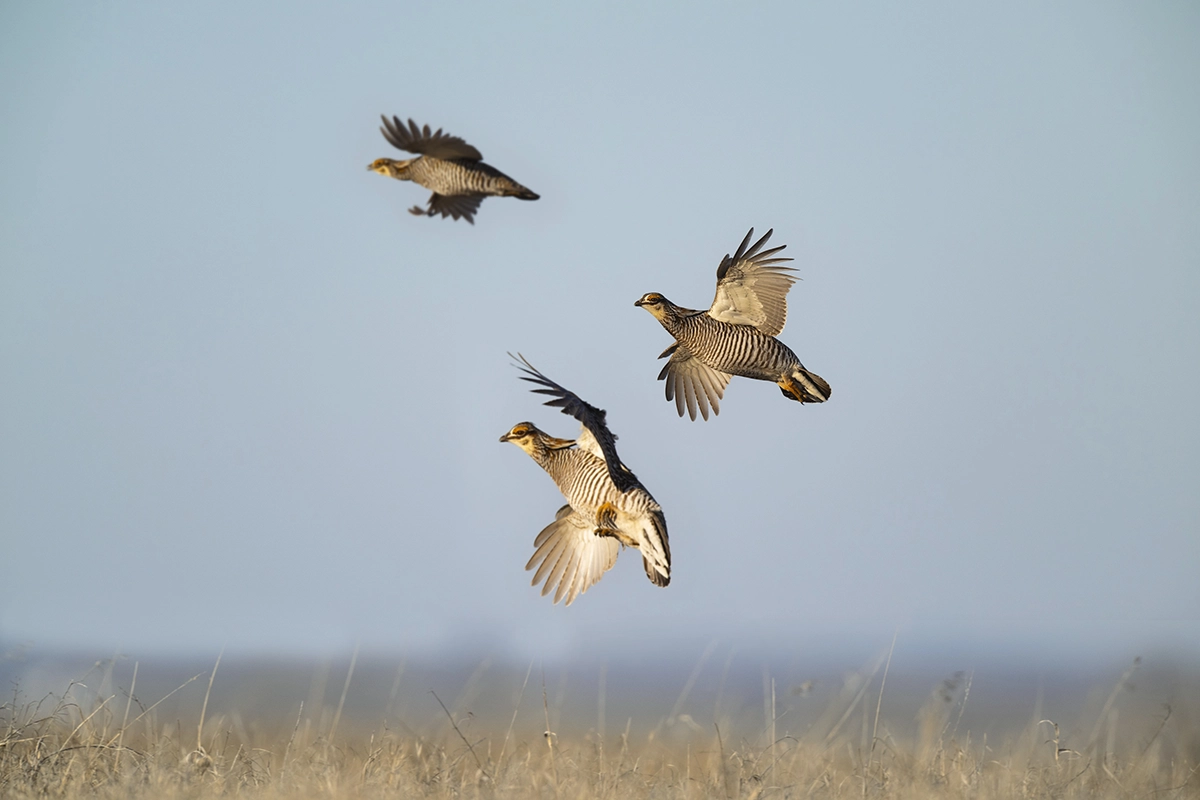
Still, I had decided to tread carefully, not even sure that I would take the daily limit of three birds, given the opportunity. (Nebraska’s limit combines sharp-tailed grouse and greater prairie chickens, given the challenge of differentiating between the two in flight.) I figured that taking just one of the beautiful birds would make for a special hunt.
So this past October my friend Jack McDonald and I flew from Albany, New York, to Omaha, and then drove 2 1⁄2 hours west to the village of Wolbach, in the southeastern traces of the iconic Sandhills. Chris’s grouse camp is a 1980’s-era split-level surrounded by soybean and alfalfa fields. It’s impossible not to be struck by the uniquely American contrast: the historical vastness of the plains dotted by a suburban-style home. After a healthy dinner of lasagna made by Chris’s wife, Shannon, we went to bed early, fatigued from a long day of travel and anticipating walking a half-marathon on the prairie.
The next morning after breakfast I climbed into Chris’s Suburban while Jack rode with Jaxon Sorensen, a second guide who would serve as a photographer. We had driven for only 10 minutes and passed through a cattle gate when Chris came to a halt, spying about three dozen prairie chickens flying across our intended hunting area before settling into an alfalfa field a couple of miles away. “Shoot,” he said. “Chickens don’t like moisture, and I’d hoped the dew point would hold. I wanted to wait it out a bit, but they’re already on the move.” We turned and headed to the next spot.
The second leg took 30 minutes, during which time Chris and I got to know each other while comparing deer sizes and hunting techniques that separate Nebraska and New York. I also learned that Chris leases more than 20,000 acres of property that sustain his turkey, deer and wingshooting operations. (In addition to chickens, there are ample populations of sharptails, doves and pheasants.) He described the grounds as a virtual hunter’s paradise.
As we turned onto a sandy road, the dogs seemed to grow anxious and impatient. We would be hunting a grassy, previously grazed field that Chris had held for this time of the morning. “I haven’t hunted this plot since the start of the season,” he said, {and birds like to come back here and feed once things start to dry off. They’re standing guard as they begin to loaf.”
It turned out that Chris was right. In the midst of a four-mile hunt-hike, we first came upon a single chicken that flushed whisper-quiet before I could get a shot. Fifteen minutes later a pair of sharptails flushed in front of a German shorthair named Stormy just as she was locking up. Unfortunately, I missed two very makeable shots as the birds banked right and away.
For the next several hours we walked up and down hills covered with topsoil that hid remarkable sand dunes. If we had been farther north and west, that cover would have been blown or washed away, revealing the prehistoric bottom of a giant 2,000-mile-long inland sea known as the Western Interior Seaway. Today the agricultural fields feed America’s beef industry and produce soy, wheat and alfalfa. The grazed terrain where we were hunting was spotted with moisture-sucking cedars, yucca, prickly pears and natural prairie grasses. Occasionally we’d chance upon hemp plants, likely fostered by a mix of Czech, German, Polish and Swedish settlers for everything from cloth to rope.
Fortunately the ground we were covering also yielded a mix of upland birds. I missed a pair of whisper-quiet chickens before being startled by an out-of-season covey of two dozen wild bobwhite quail. I must confess that, as the walking continued, my confidence slowly waned. I tried to quiet the inner voices that suggested I was more likely to miss than connect on the next opportunity. Soon a single chicken flushed, but its low flight path took it in front of the other shorthair, Reign, so I held fire. Then an impressive covey of 10 chickens got up in front of Reign’s point, and in my haste I flock-shot, proving again the fruitless folly of that technique.
Shortly thereafter Reign locked up above a cluster of low cedars. This time, instead of challenging me with a 30-plus-yard flush, the chikens got up at about 10 yards and flew low and straight away. I managed to drop one, and Reign retrieved my first-ever prairie chicken—a large, mature male. I marveled at the long pinnae feathers on the bird’s neck and the gular sacs (the yellowish membranes that male chickens inflate with air to produce booming sounds during mating season). “You can’t believe how far that sound travels,” Jaxon said. “You can hear it miles away.”
We continued walking, and soon I connected on a second chicken—this time a younger female. And while we could have hit another spot and tried for my bag limit, I was feeling the 19,328 steps I’d already taken and opted to save my energy for the following day.
The start of the second morning again provided the immediately satisfying, blood-pumping confirmation that I’d come to the right place. On our drive into what would be our sole location for the day, a lone chicken stood proudly on a weather-beaten fencepost, craning its neck as it listened and watched for threats. As we inched forward, six birds launched from the grass and flapped toward the horizon.
We continued on for about 15 minutes, and then set out walking in another grown-up pasture.
Which brings me back to the initial scene—me hotfooting it uphill, with Chris urging me on toward a shorthair on point. And then it began: one bird . . . then three more . . . then another. Like popcorn on a hot skillet, chickens began busting out all around. Left, right, center, behind. High, low, quartering, banking. They were suddenly and silently everywhere. Chris and Jaxon were pointing and calling out birds. I was spinning and whirling, taking it all in but at the same time a bit dazed and confused. It was an epic wingshooting moment. And when it was all done, about 30 prairie chickens had gotten up. With some room left in the bag, we continued on.
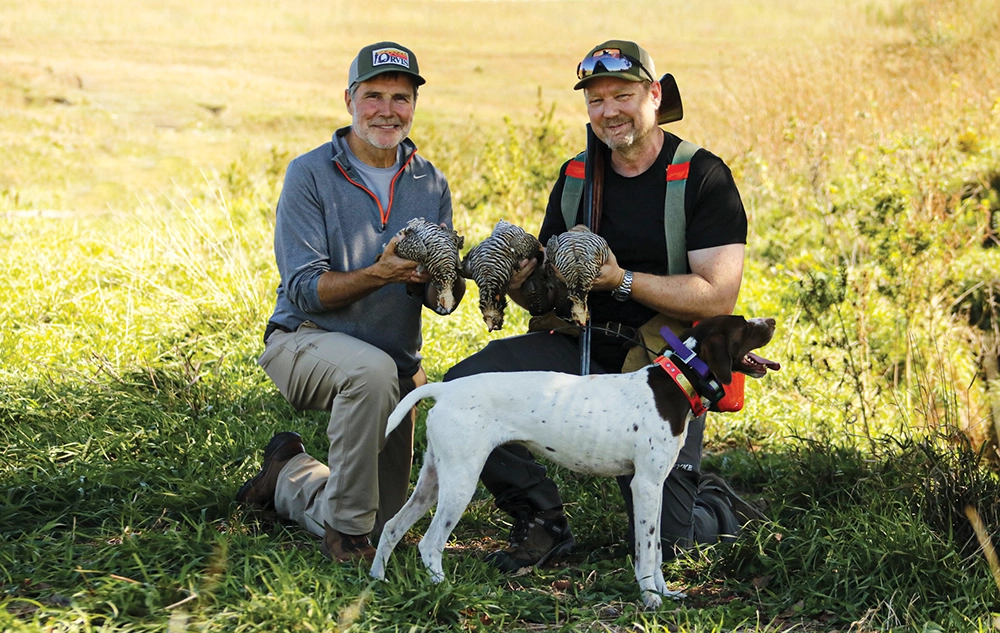
By 2 PM I had taken my limit of three chickens, including one in ruffed-grouse-hunting style—snapping off a shot through a tree and tumbling the bird on the other side. As I admired the trio of barred-feathered trophies, I couldn’t help thinking about the species’ tenaciousness. These were descendants that had eked out a living amid avian predators, hungry coyotes and foxes, brutal droughts, punishing rains and, of course, overzealous market hunters who’d seen dollars instead of feathers. They’d clusted in coveys with watchful eyes near the tops of ridges on these windswept plains. Furnace hot in the summer, frigidly cold in the winter, these plains have a serene beauty that hides the threats to these iconic birds. It’s been repeatedly told that Benjamin Franklin wanted our national bird to be the turkey. I dare say that if the country had been founded smack in the middle of the continental heartland, it should have been the prairie chicken.
Read our Newsletter
Stay connected to the best of wingshooting & fine guns with additional free content, special offers and promotions.