

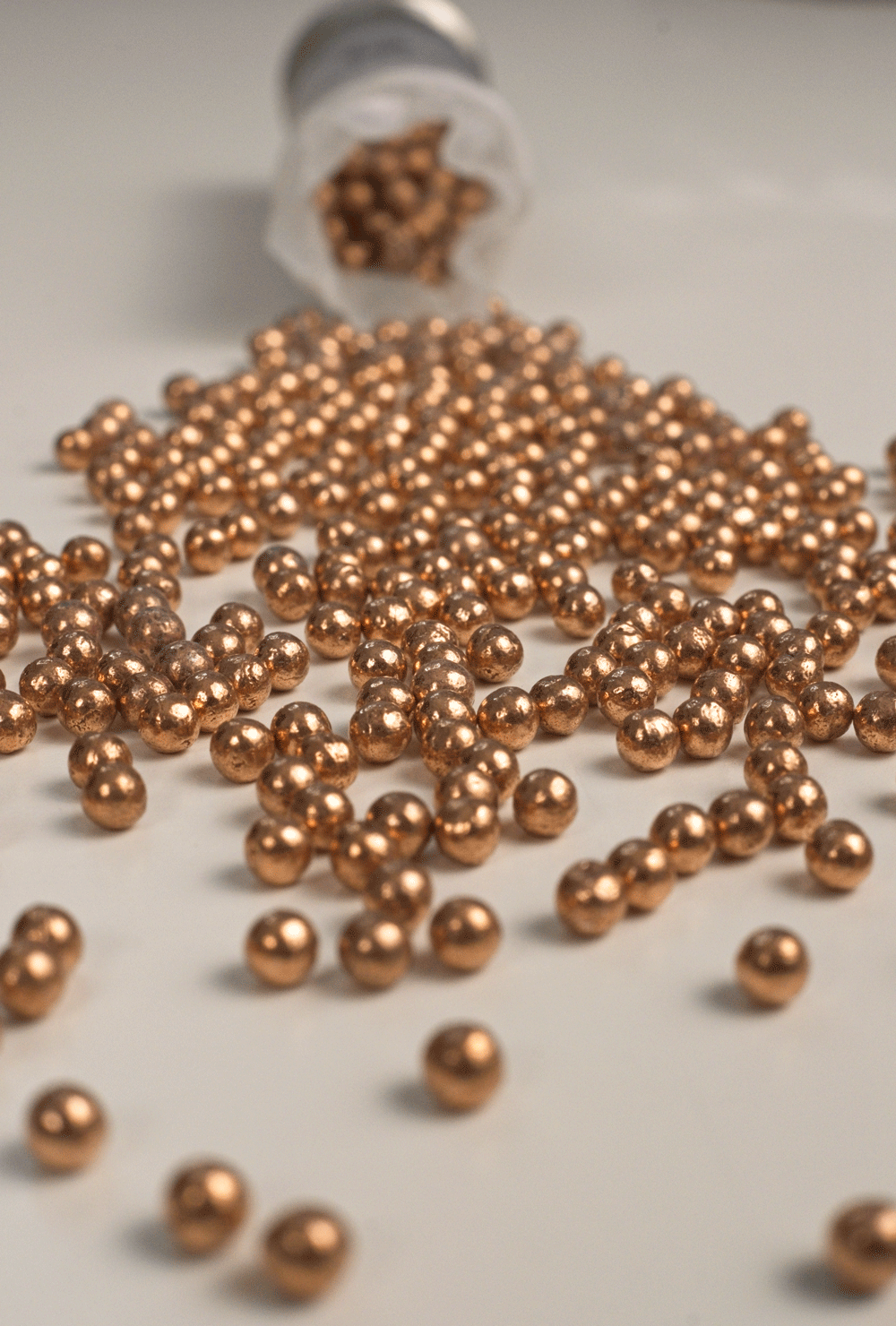
One issue dominated my reader mail in 2025 and has continued strongly into 2026: so-called copper shot. While I touched on this subject in January/February (see “Understanding Plated Shot”), given the volume of questions I continue to receive, more ink is required to clear up the facts concerning this possible new shot type. Following is a rundown of the most common issues, misunderstandings and rumors I have heard so far.
Calling all variations of pellets with copper in or on them “copper shot” continues to mislead many shotgunners. Lately this longstanding misnomer has caused many to assume that soon there will be coming some magic pure-copper pellet or that there already is one being used. Reality: As noted in my January/February column, pure-copper pellets are illegal for waterfowl hunting, as long ago they were proven to be toxic to ducks, and they are not being produced or shot anywhere. There are, however, copper-plated pellets that have long been in use—originally all legal but now those with lead cores are not legal wherever nontoxic shot is required.
There also exist two forms of high-content-copper pellets that have been toxicity tested and are federally approved in the US. One is called corrosion-inhibited copper (CIC) shot. This copper-based pellet variant is defined by the US Fish & Wildlife Service as “containing greater than or equal to 99.9% copper with benzotriazole and thermoplastic fluorescent powder coatings.” So far CIC shot has not been available, but it is claimed to be coming “soon” from one US shotshell manufacturer and one reloading-components supplier. Another form is called copper-clad iron, and it is defined by the USF&WS as having an “84 to 56.59% iron core, with copper cladding up to 44.1% of the shot mass.” One copper-clad-iron variant pellet was named Speed Ball and was briefly marketed by HEVI-Shot (now The Kinetic Group) about 10 years ago but has been discontinued.
So let’s assume that CIC shot variants might be successfully made and clear all the real-world hurdles to progress from concept to physical product. Then they must be tested and granted federal approval as a nontoxic shot type for waterfowl hunting before they are legal. But at press time this hasn’t happened. So hunters beware that there are various so-called “copper shot” types being manufactured and sold, but they are not automatically legal.
The reason CIC shot may be coming on is because bismuth shot is becoming increasingly more expensive to manufacture due to difficulties of importing raw bismuth from China and the ever-increasing price China is putting on this metal. This has caused Boss in particular to recently give up bismuth-shot manufacture and start considering the production of its version of CIC shot. This makes good business sense, because copper can be sourced exclusively in the US and is not dependent upon China or any other foreign entity as a source of supply.
But the path to becoming a full-blown marketed CIC pellet sold in sufficient volume to be profitable will not be an easy one. The reality is that Darryl Amick, formerly associated with Environ-Metal—now The Kinetic Group—patented CIC shot in 2017. Knowing and respecting Amick well, the fact that The Kinetic Group has never marketed CIC shot tells me there are lots of hurdles involved, especially considering how CIC shot compares to bismuth and steel shot as a nontoxic alternative. So let’s examine how bismuth, copper and steel stack up against one another ballistically, cost-wise and in manufacturing difficulty.
While steel-shot density rounded up is basically 8.00 g/cc, bismuth/tin rounded up is 10.0 g/cc and pure copper falls smack dab in the middle at 9.0 g/cc. If bismuth falls by the wayside, we lose a two-steps-up (25% denser) pellet than steel and have it replaced by copper, which is a mere one step up (12.5% increase). That’s not a significant difference in density from a ballistic standpoint. So don’t look forward to “copper shot” being some miracle, high-density, significantly more-lethal pellet like, say, HEVI-Shot or something approaching lead. The fact is: From a density and lethality standpoint, “copper shot” is going to be pretty close to steel shot.
From a hardness standpoint, bismuth measures 2.0–2.5 on the Mohs scale, while copper measures 2.5–3.0. In other words, both are classified as relatively soft metals. So don’t expect CIC shot to pattern much better than bismuth, because they’re both so close in softness and thus easily deformable. But the advantage of “copper shot” will be that it will not be brittle and vulnerable to busting into pieces like bismuth does inside the barrel and upon contact with hard bird tissue. Steel shot, of course, is much harder than both, doesn’t deform in the barrel or upon target contact, and thus delivers much-superior patterns to both.
In terms of cost and according to the website Trading Economics (tradingeconomics.com), at the end of 2025 raw copper was going for $5.84 a pound, experiencing strong demand because of its wide variety of uses. It saw a 42% gain in price is 2025—and its price continues to rise. While not a good materials-cost trend, this is an advantage over bismuth, which ended 2025 at $15.75 a pound for the raw material and is still seeing a rapidly rising price. But as always, raw, low-carbon steel beat them both, ending 2025 at only $1.55 a pound.
Last, consider manufacturing techniques. Bismuth shot is quite easy to make by the Bleimeister method, which involves dropping a molten bismuth/tin mixture through a sieve and then having the droplets make a short fall through water to finish-form the pellets into fairly round shapes. Bismuth also enjoys a very low melting point of 520°F, so it can be easily melted (like lead) without a tremendous electricity cost. This enables the pellets to even be fashioned at home, which has been done by shotgunners for years in Australia. Copper, however, has an extremely high melting point of 1,984°F. This creates a huge electricity demand and the resulting cost. But if CIC shot could be formed by the standard steel shot method—which in this case would be to take copper wire, chop and head it to shape, and then chemically treat it with benzotriazole (BTA) to create a protective hydrophobic layer—the pellet-forming cost would be comparable to that of steel shot.
We shall have to wait to see how all of this translates into the final cost of CIC shot production.
In conclusion and by objectively looking at the facts, it seems to me that if CIC shot comes to market, it may be a less-expensive alternative to bismuth shot plus be attractive to those worried about their guns/chokes being damaged by hard shot. But it will not perform as well ballistically and offer lethality as high as bismuth shot or especially as high as steel shot, provided that it is being compared to the necessary one-size-larger steel pellet. And CIC shot, like steel shot, will need a fully two-sizes-larger pellet to compare ballistically to lead. One thing is for sure: If a shotshell company comes out with a strong-selling CIC pellet load, you can bet that competitors will soon jump on the bandwagon with their own versions. And then, as usual, no manufacturer will have an exclusive, and its CIC loads will have plenty of competition.
To consult with Tom Roster or to order his new Advanced Lead & Bismuth Shot Handloading Manual, his current HEVI-Shot and HW-13 reloading manual, or custom loading data, contact Tom Roster, 1190 Lynnewood Blvd., Klamath Falls, OR 97601; 541-884-2974, tomroster@charter.net
Read our Newsletter
Stay connected to the best of wingshooting & fine guns with additional free content, special offers and promotions.