
From our July/August 2026 issue
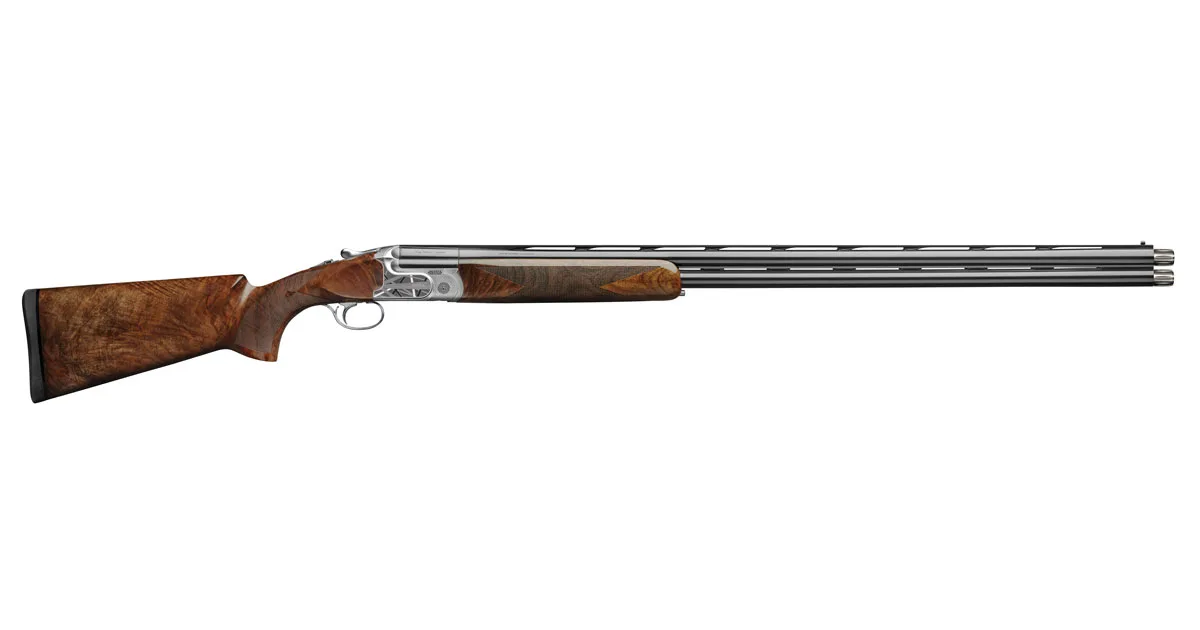
The indomitable Caesar Guerini Invictus came to fruition in 2014. Add some barrel wizardry a decade later, and we arrive at the 12-gauge Invictus Artco Specialist. The Invictus was born of Antonio Guerini’s answer to the question of how to improve a shotgun’s longevity: US Patent No. 9,945,624. Digesting the patent’s technicana was a Sisyphean task that I abandoned post haste. But shooting this manifestation of the patent was an endeavor I was loath to abandon. Priced at $11,800, the Artco Specialist enters a rarified world of sporting shotguns, so there must be compelling reasons to make the investment. Guerini literature states: “This is a competition shotgun that is not for every shooter like an F1 race car is not for every driver." That said, the tech behind the Invictus action, the extraordinary manufacturing standards and execution, and the handling and performance of this shotgun are reasons enough to buy it and try to shoot it for Guerini’s promised longevity of “a million rounds."
Orvis has a two-decade relationship with Caesar Guerini. Dozens of Guerinis serve as loaner guns at the three Orvis Shooting Grounds. I use and see Guerini shotguns in action daily. Customers rarely respect rental guns as their own. The guns are often treated like rented mules, but they endure and their performance rarely wavers. With the Artco, Caesar Guerini has continued to deliver on its promise: to combine “legendary Italian gunmakers’ craftsmanship with state-of-the-art processes” to produce a durable and beautiful gun. Like Rome’s Colosseum and Pantheon, the Artco is art designed to withstand the test of time.
SNAPSHOT
- Make & Model: Caesar Guerini Invictus Artco Specialist
- Gauge: 12
- Action: Triggerplate over/under
- Chambering: 2¾"
- Finish: Nickel with Invisalloy protective finish and proprietary engraving
- Barrel Length: 34"
- Weight: 8 pounds 5 ounces
- Chokes: 6 E-22 Maxis Ultra-lightweight Grade 5 titanium chokes with case
- Stock: 14¾" LOP, 1½" DAC, 2¼" DAH, 1/8" cast at heel, ¼" cast at toe, 5° pitch
- Accessories: Negrini hard case, stock and trigger tools, limited lifetime warranty
- Price as tested: $11,800
The Artco’s 34" deep-drilled, chrome-lined barrels were crafted with an extraordinary level of precision and weight mitigation. The steel showed no anomalies beneath the pristine black gloss finish. The muzzles were crisp and uniform. The 10mm-to-6mm tapered top rib is machine filed with a crosshatch pattern. Its narrow grooved center sports a white Bradley front bead and silver center bead. The truncated vented mid-rib extends 23½" from the muzzles. There is no mid-rib from the forearm to the monoblock, to reduce weight. The rib jointures were flawless. The bottom barrel met the monoblock with a barely visible, perfectly aligned seam. The top-barrel seam is touched with decorative scroll. The machining for the lugs, breech, bites and Invictus cams (which replace traditional hinge pins and trunnions [see below]) was immaculate. The same was true for the tick-tight ejectors, which expelled spent shells uniformly five feet over my shoulder during test-firing. The sides of the monoblock are finished in Guerini’s nod to a Damascus pattern. It is slightly textured and resembles The Joshua Light Show from a ’60s concert—though without the psychedelic colors and a lot less trippy in muted silver and gray. The bottom of the monoblock is blued.
The 2¾" chambers transition to 5" DuoCon forcing cones into 22½" .735"-diameter (nominal for 12 gauge is .729") chrome-lined barrels. Guerini, like other manufacturers, makes claims about increased velocity, less shot deformation and decreased perceived recoil, thanks to a longer and less-abrupt transition to the bore. I have yet to see the science behind any of these claims. That said, the magic in the Artco’s barrels lies in the new 3½" E-22 Maxis Ultra-lightweight chokes, crafted from German Grade 5 titanium. These gossamer extended sporting chokes are something to behold. The Cylinder, Skeet, Improved Cylinder (x2), Light Modified and Modified chokes all measured spot-on nominal constrictions. They have fluted extensions that mate with Guerini’s proprietary choke wrench. This clawed device requires a learning curve to use and would be best replaced by a proper friction wrench. Constrictions are noted on the extensions and shafts. The chokes settled smoothly in the muzzles and stayed put.
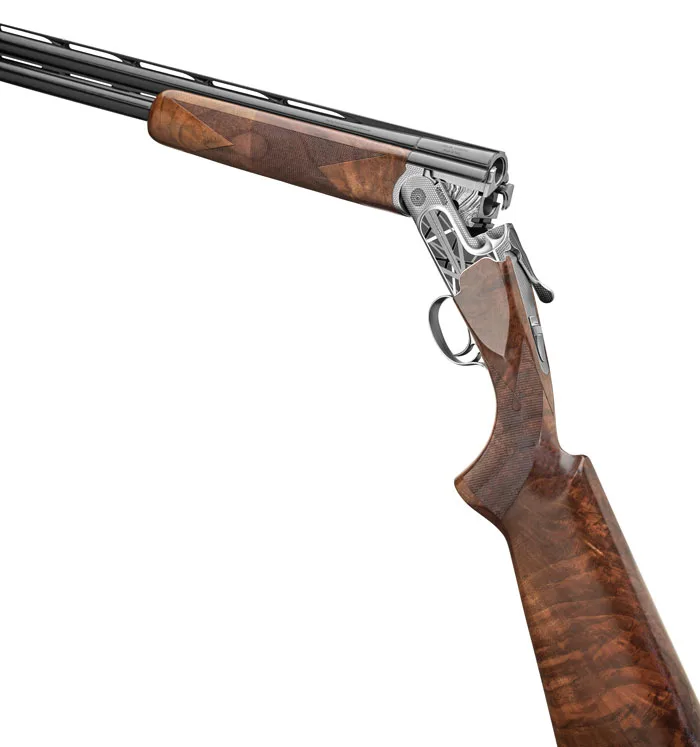
The heart of every Invictus is its patented lock-up. Guerini engineers looked at the traditional pivot points and bearing surfaces of shotguns and created a design that would increase long-term durability by mitigating the forces that often leave shotguns “off-face" and loose after thousands of rounds. The result is a modular system that adds the aforementioned Invictus cams on the monoblock that engage cutouts in the action walls and place the Invictus block in the well of the action. Guerini maintains that these are “more durable from the start and can be rebuilt in a way no other over/under can.” Thus, the barrels pivot on the cams. A large mating surface at the front of the monoblock locks behind the Invictus block. Lastly, a traditional broad underbolt emerges from the action face and engages a bifurcated bite at the rear of the monoblock.
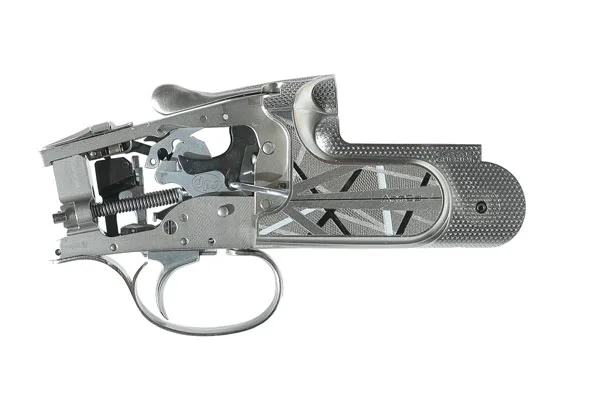
The Artco’s nickel-finish action has a deconstructed aesthetic with its combination of angles and textures in gray, silver and black. It is modern and iconoclastic. Like Bauhaus architecture, not everyone is going to like it—and liking it does not make me a Philistine. If it is an acquired taste, it is one I acquired with alacrity. The bolsters are adorned with textured circles, intersecting lines, geometric patterns and crosshatching contrasted with bold gray and black enamel bars. The rest of the action wears a pattern of crescents, and “Caesar Guerini" is etched on either side of the receiver. The smooth-opening toplever shares the crescent pattern and bold vertical bars. The stippled manual safety and integrated serrated barrel selector look like standard-issue Guerini and operated smoothly and positively. The underside of the action and trigger guard share an amalgam of the bolster pattern and crescent pattern, with “Invictus" running vertically down the middle. The knuckle is polished, and the walls, well and action face had a matte finish free of any blemishes. The well is dominated by the hulking gold-colored Invictus block, which sits above a single black steel cocking bar. The exterior surfaces are treated with Guerini’s Invisalloy protective finish.
Looking at the internals, Orvis Gunsmith Connor Carson remarked that they look like those of Guerini’s venerated Summit Sporting “on steroids." He was onto something here. Every part exhibited a stunning level of rigor and refinement. Massive forged chromed steel hammers and equally beefy sears pivot from the top. The blued steel ejector ears and white steel spring bars sit in the front and appear larger than standard Guerini parts. The stamped steel disconnector, machined steel lifter and forged inertia block sit in the middle. Parallel coil-spring assemblies run along the bottom. The safety spring and barrel selector are at the top. The sears, hammers and trigger make up the Invictus DPS (durability, precision, speed) trigger system, and the delightfully crisp inertia trigger had 1⁄32" of take-up, zero creep and broke at 3½ pounds. The adjustable trigger allows ⅝" of travel. Take-up and over-travel are adjustable, as well, but a company gunsmith advised that these adjustments are best left to a competent gunsmith.
With the $11,800 price, I expected gobsmacking wood. It was hardly pedestrian, but I have seen better on lesser Guerini models. I suppose it begs the question: Is one paying for performance or aesthetics? The cost for both in equal measure can be prohibitive, and my preference is for performance. The Turkish walnut did have appealing dark-and-light contrasts and dancing waves of figure. A few subtle burls added spice. The grain through the wrist was straight and strong. The low-gloss, hand-rubbed oil finish was uniform and had been applied liberally on mating surfaces in the stock head. A pronounced palm swell filled the hand without feeling excessive. The angled-knob pistol grip had excellent geometry with an accommodating wrist and reach. My thumb rested comfortably at the sculpted nose. The 26 lines-per-inch checkering had crisp diamond points and keen borders, and the drop points were attractive. The wood-to-metal fit was fantastic. Stock measurements were to Guerini specs: 14¾" length of pull to the back of a rubber pad, 1½" drop at comb, 2¼" drop at heel, ⅛" cast-off at the heel and ¼" at the toe, and 5° of pitch. (Left-handed stocks and adjustable combs are available for an additional charge.)
The forearm was equally well executed, with fabulous inletting for the iron. The knuckle hook is adorned with the same crescent pattern as the action. There appeared to have been no shortcuts taken with the oil finish, and the entire underside was covered. Bravo! The pushbutton release has had an elastomer bushing added to the assembly to reduce vibration between the release and the wood. Additionally, an Action Control System allows user adjustments to forend tension. Shooters can be fastidious about this, and it is nice that Guerini has been so attentive. Accordingly, the release and attachment were trouble free.
Having briefly shot the Artco at an Orvis event last summer, I was eager to dedicate more time to the gun. Fully assembled, the Artco weighed 8 pounds 5 ounces. It balanced right at the knuckle, and the weight fell uniformly between my forehand and the wrist of my trigger hand. Shooting 2¾" Winchester Light Lead Loads with 1 ounce of No. 7½ shot at 1,180 fps and Modified & Improved Modified chokes, the gun patterned 50/50 with perfect convergence. Recoil was negligible.
A number of curious peers accompanied me to the 5 Stand and different sporting clays stations to have a go. Pre-mounted shooters remarked on the Artco’s immediate responsiveness. Gun-down shooters praised the graceful ascent to the face and a nimbleness that belied the 34" barrels. I am a self-effacing clays shooter and must say the Artco made me better. The gun was very responsive and made for speedy target acquisition and agile adjustments. Moving swiftly from target to target on true pairs, I broke clays that I normally miss. Crossers and an outgoing “bumblebee" (60mm)clay that typically flummoxed many of my peers were dropped with aplomb by all of us. Many of the clays were crushed, leaving behind gratifying orange puffs. “Maneuverable,” “responsive,” “forgiving” and “smooth” were oft-heard descriptors. Guerini has really done something special with the Artco. It has a sublime quality that leaves shooters wanting more.
Yes, the Artco commands a handsome price. Spending north of $11,000 on a shotgun merits deliberation. But given the Artco’s patented technology, groundbreaking design, near-flawless execution and extraordinary performance, it stands to reason that thereis compelling evidence to add this gun to the safe. Indeed, an F1 race car is not for every driver, and the Artco is not for every shooter. On the other hand, I’m willing to pretend I’m Sir Jackie Stewart and shoot an Artco every chance I get and can only hope to reach 1,000,000 rounds.
Greg Carpiniello is the Gun Department Manager for The Orvis Company. His home base is the Orvis Sandanona Shooting Grounds, in Millbrook, New York. When he’s not selling guns, he can be found chasing woodcock.
Read our Newsletter
Stay connected to the best of wingshooting & fine guns with additional free content, special offers and promotions.