


From our November/December 2025 Issue
When I began working at Orvis a decade ago, Gunsmith John Skinner schooled me on the history of Orvis’s proprietary shotguns. Grulla figured prominently. In fact, in 1973, when the gunmaker was known as Union Armera, Grulla made Orvis’s first custom side-by-sides. The guns were lovely, modestly adorned and noted for their short barrels and detachable sidelocks. Skinner held them in high regard, which was a ringing endorsement. Orvis moved on to several other Spanish makers and settled on Arrieta. When Arrieta became insolvent, in 2016, Grulla’s Export Manager, Inigo Usobiaga, traveled to Manchester, New Hampshire, to renew the relationship. That reunion resulted in this month’s delightful review gun: a Grulla 216RB (round body) 20-gauge with 30" barrels.
The 216RB arrived in the shop in a classy canvas case with leather trim. Opening it revealed an elegant and sleek shotgun. Everything that is “not gun” is stripped away, leaving a lithe beauty that is a celebration of exactitude in gunmaking. Depending on custom options (and looming tariffs), it can be had for around $16,000—and is worth every penny.
When digging deeper into Spanish guns, I always consult Terry Weiland’s pithy-yet-instructive book Spanish Best. Grulla’s history began in Eibar in 1932, when six master gunmakers left the gunmaking firm of Sarasqueta to create Union Armera and chose the crane (“grulla” in Spanish) as their trademark. They made boxlocks, sidelocks and components for other makers. The Spanish Civil War disrupted operations from 1936 to ’39. Afterward, Union Armera focused entirely on sidelocks and became well known outside Spain where the company’s guns bore the names of William Powell, Auguste Francotte, Griffin & Howe and Orvis. By the mid-1980s Union Armera’s founders had passed away and an all-too-common period of financial instability beset the company. Managing Director Jose Luis Usobiaga reorganized Union Armera, fortified the finances and focused on high-grade, handcrafted sidelocks under the name Grulla.
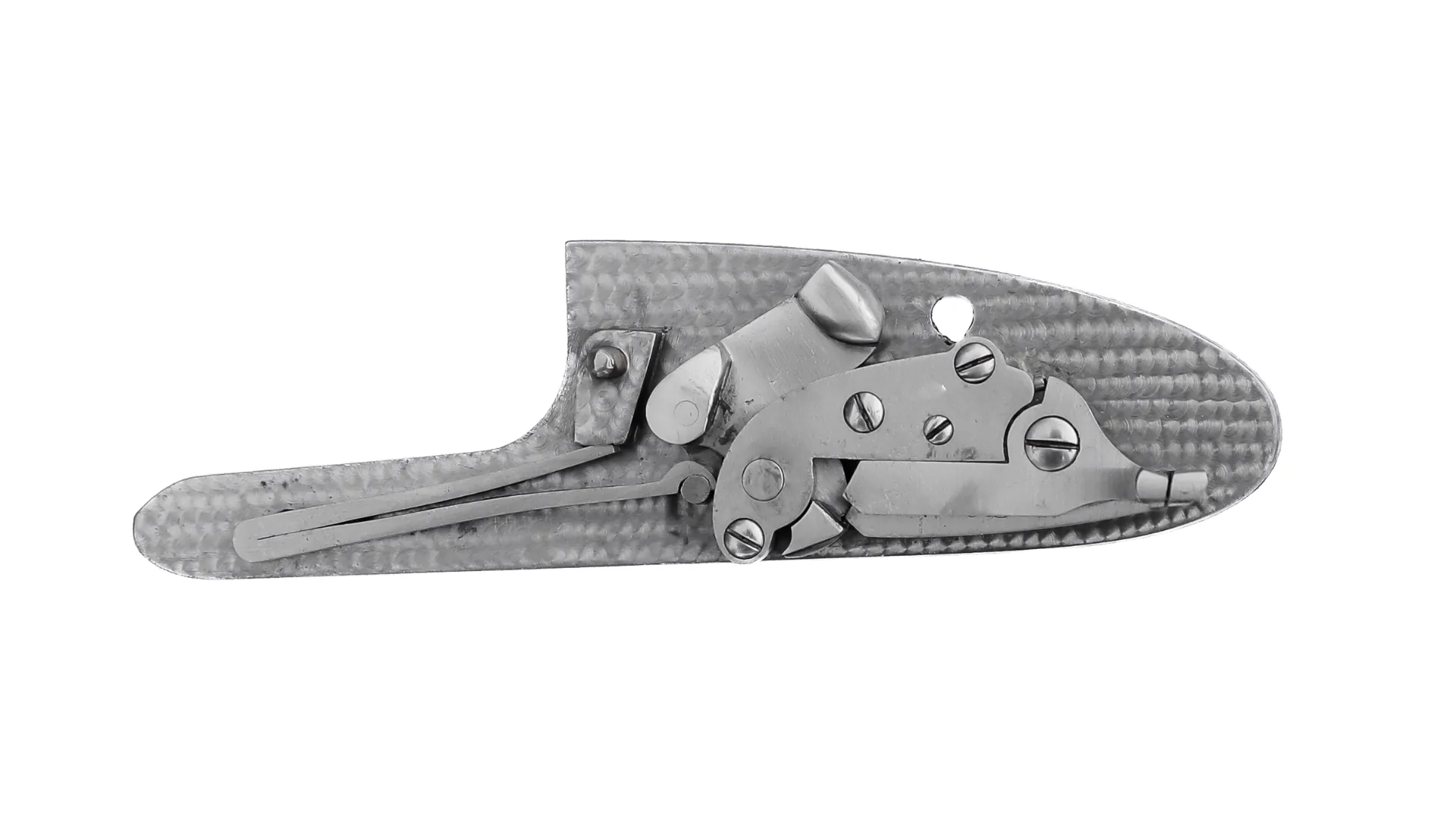
The 216RB is a precious little bird gun. Even with the 30" barrels, it weighed a mere 6 pounds 3 ounces on our scale. (The model is also available in 12, 16 and 28 gauge as well as .410 and with barrels down to 26".) The action is a Holland & Holland-style five-pin bar-action sidelock with coil-spring intercepting sears, gold-accent cocking indicators, and gas escapes. The polished “old silver” receiver (a case-color-hardened finish is an option) had full-coverage Purdey-style rose & scroll engraving. While not deep relief, the engraving was exceptionally well executed and reflected the meticulous work of a master. The sculpted fences were a triumph! The wood-to-metal fit was amazing. There were no unsightly haps or irregularities, and the wood was slightly and appropriately proud at the edges of the locks and receiver.
I approach the removal of sidelocks with great trepidation, so I deferred to Orvis Gunsmith Connor Carson to avoid any foolish damage. Carson immediately complimented the use of a small lock screw to provide added security to the main screw. The interior face of the lock was engine turned. There was no artistic pattern, but there was full coverage nonetheless. The forge-polished steel, hand-fit mainsprings, hammers/tumblers, bridles, safety sears and main sears were noted for their precise fit and lack of stray filing marks. A good deal of patient handwork was evident in the lock assemblies. The inletting was precise, and all of the wood was oil finished. There was some minor roughness along the outer edges but nothing to impede proper function. The remainder of the action was spectacular. The face was highly polished and had disk-set strikers. The flats were engine turned. The knuckle was gleaming and flawless, and the stout ejector cams had no careless wiggle or play. Lock-up was vault tight, with the bolt engaging two bites in the barrel lumps.
The two silver triggers (the front is articulated) broke cleanly at 4 pounds each, and the trigger guard had a rolled edge for a right-handed shooter. The stippled toplever moved to the right effortlessly, and the gun opened and closed in silken glory. The manual safety operated with a plump stippled ball adorned with a gold “S.” It was positive with definitive-yet-effortless clicks to and fro. There was a smoothness here that ought ot be the envy of all gunmakers. The safety was that nice!
The 30" barrels were a delight. A great deal of care went into striking and assembling them, as evidenced by the uniform level of polish and lack of any discernible blemishes. They sported a low-gloss blued finish that presented as dark gray with a suggestion of sheen. The muzzles were near perfect save an uneven bit of solder fill on the rib end plugs, but there were no gaps. A concave game rib sat low between the barrels and tapered from 5⁄8" to 3⁄8" and was finished with a single brass bead. “Grulla Armas SL, Eibar Spain” and “The Orvis Company Manchester VT 20g 3 in.” were stamped on the barrels near the breech. The rib jointures were flawless. There was a modest touch of decorative scroll at the breech end. The chopper lumps were expertly joined, with no visible seam. The barrel flats and bottoms of the lumps were engine turned, while the sides of the lumps were highly polished. The cuts for the hooks, draws and bites were exceptional. The breech end gleamed, and the well-fit and timed ejectors aggressively propelled spent shells at least 10 feet during test-firing.
The 3" chambers transitioned to 1⁄2" forcing cones. The bores measured .627", significantly more than nominal (.615"). The chokes were designated Improved Cylinder & Modified. The IC choke actually measured .011", so closer to Light Modified. The M chokes measured .020", so closer to Light Full. The measurements confirmed my experience with many Spanish and French customer guns: that the chokes are more often than not tighter than what is designated. This is why I tell clients ordering such guns to specify chokes in thousandths of an inch rather than rely on common choke nomenclature. All Grulla barrels are chrome lined and steel proofed up to Modified choke.
The glorious barrels and action were mated to an entrancing piece of dark Turkish walnut festooned with horizontal waves and tornadic swirls of dark figure. The hand-rubbed oil filled the grain, and the glossy finish was striking. Stock measurements were: 15" length of pull to a checkered butt, 1 1⁄2" drop at comb, 2 3⁄8" drop at heel, 1⁄8" cast-off and 5° of pitch. The straight wrist was hardly dainty. I know some shooters would prefer something slenderer, but I liked this straight stock, which filled my hand satisfactorily. The hand-cut checkering had well-defined, albeit somewhat-shallow, borders. My only quibble was with the slightly asymmetrical points on the port side of the stock near the top tang and trigger guard. The checkered butt was refreshingly well executed and distinct from much of what I see out of the Spanish trade. Often gun-butt checkering seems like an afterthought, as if the stocker remembered to complete the task as the gun was going out the door. Not here. The symmetry, border and depth were perfect.

The tapered splinter forearm was very nice. Like the wrist, it was not too dainty in the hand. The inletting for the iron and Anson-style pushbutton was excellent. The iron was a robust bit of polished steel, and the knuckle hook was polished to perfection. The fit around both escutcheons was excellent. The checkering was symmetrical and crisp. The stippled button released with a gentle push, and snapping it back into place was a cinch. A commendable level of gunmaking is necessary to create such a gratifying experience out of such a mundane routine.
As mentioned, the 216RB is a proper bird gun. Unfortunately, I reviewed it during a sultry spell of June weather. In lieu of chasing birds, Connor Carson and I carted it to the patterning board and around the sporting clays course, and it performed flawlessly. Shooting Winchester Super Target 2 3⁄4" 1-oz 1,180-fps No. 8s, the gun patterned a touch high at 60/40. Barrel convergence was perfect. Recoil was negligible. The action was simply a joy in the hand. The gun balanced just in front of the knuckle, with perfect weight distribution between the hands. This wand of a shotgun was lively and nimble, and it arrived gracefully at the face.
I wanted to shoot the gun better than I did. Frankly, I ought to spend more time behind double-trigger guns than I do. So I had to contend with that learning curve. I also needed to get my head on the stock and float the targets. Once I settled in, though, I started crushing high incomers and straightaways. i was able to stay in the target zone on easier report pairs. Despite the smooth, even swing of the 30" barrels, sharp crossers and chandelles flummoxed me. It was hardly the gun’s fault. i suppose that, with more time, I oculd tame those wily triggers and the gun itself and enjoy more success. On the other hand, Carson shot the Grulla like a por and may have tried to sneak it to his truck at the end of the afternoon . . . .
Catalan Modernist Architect Antoni Gaudi stated: “The straight line belongs to man. The carved lines belongs to God.” While I do not intend to deify a shotgun, Grulla certainly embraces Gaudi’s intent in the construction of the 216RB’s action. It is a well-crafted specimen of curved beauty that carries with ease and deserves to be in wide-open grassy quail cover or manipulated through tight brambles in pursuit of grouse and woodcock. Gaudi also stated: “My client is not in a hurry. I am a slave to my client’s wishes.” Grulla is infused with the spirit of Gaudi. I can attest to this. The company is remarkably accommodating to work with. Grulla touts its dedication to “craftsmanship, care and passion” to create shotguns according to “tradition.” The entire Grulla process takes place in-house with “artisan gunsmiths” dedicated to wood, steel, engraving and fitting. The goal is “luxury guns” noted for “quality and exclusivity.” If a client dreams of a configuration, Grulla will build it. I worked extensively with Inigo Usobiaga to develop the 216RB at hand and I am glad I did.
For more information, contact Grulla Armas, grullaarmas.com.
SNAPSHOT
Make & Model: Grulla Armas 216RB
Gauge: 20
Action: Holland & Holland-style five-pin sidelock
Chambering: 3"
Finish: “Old silver” with Purdey-style rose & scroll engraving
Barrel Length: 30"
Weight: 6 pounds 3 ounces
Chokes: Fixed Improved Cylinder & Modified
Stock: 15" x 1 1⁄2" x 2 3⁄8, 1⁄8" cast-off, 5° of pitch
Accessories: Canvas, leather-trimmed hard case
Price as tested: $16,000
Read our Newsletter
Stay connected to the best of wingshooting & fine guns with additional free content, special offers and promotions.

“2 3⁄4” 1-oz 1,180-fps No. 8s”…why on earth would you shoot 1oz loads in a light 20 ga bird gun on a sporting clays course, especially knowing the barrels are tightly choked by your measurements? The standard 20 ga target load is 7/8 oz at 1200 fps.
Otherwise the review seemed reasonably accurate, although the author surely needs to spend more time shooting a side by side. At least he had someone along that was used to shooting them.
We don’t need to hear about your incompetence with double triggers. If you are going to review guns with double triggers either learn to use them easily or leave out the comments.
F. Jack Hurley
Former Pres., Carolina Vintagers
I’ve had mine for over 20 years and love it! It is a lovely 12 ga with 28 in barrels and a case color hardened Holland and Holland pattern engraving weighing in at just over 6.5 lbs.
A Magic Wand Indeed!
I have two of them, a 16g Elite (29” barrels), and a 20g identical to the one reviewed. I also have a 215 in 12g. I love all three of them and have hunted with them frequently. They are all easy to carry in the field even when walking all they in north east Montana for Sharptails and Huns! Mr. Domek, is right- true magic wands.