
A good friend of mine born and raised in New Zealand. He moved to Canada more than two decades ago to pursue his life’s passion: falconry. He had flown his birds of prey over springer spaniels and German shorthaired pointers in his homeland, but when he moved to Manitoba, he decided to go with another breed. He wanted a hard-working pointing dog capable of dealing with the tough cover and harsh climate of central Canada. After weighing the pros and cons of several breeds, he chose a German wirehaired pointer.
After acquiring two males and hunting with them for several years, he decided to add a female to his kennel. I was there when she arrived by plane from Germany. Despite having spent more than 14 hours in a crate, the minute she got out, she jumped into her new owner’s arms, licked his cheek and then ran to a small pond on the other side of the yard. When she got to the edge of the water, without hesitation she dove in and gave chase to a family of ducks. She was four months old.
That pup eventually grew into a superb gundog. To me, she will always represent the very essence of the German wirehaired pointer: a rough-and-tumble, intensely loyal, hard-working gundog. And the fact that a falconer from New Zealand living in Canada could get a pup from a breeder in Germany and have it start hunting the minute its feet hit the ground is a testament to the incredible achievements of a small group of people who had the courage to follow a revolutionary idea nearly a century ago.
“Build a better mousetrap, and the world will beat a path to your door.” —Ralph Waldo Emerson
The story of the German wirehaired pointer begins around the turn of the 20th Century, as the early experimental period of dog breeding was drawing to a close. By then, many breeds had been declared separate and distinct, and their stud books were closed to so-called foreign blood. Kennel clubs, registries and breeding associations were forming across Europe, and breeders were lining up to earn blue ribbons in the show ring for “improving” their breeds.
Many breeders based their selection of breeding stock on two main criteria: appearance and pedigree. They believed that selecting the best-looking animals and maintaining them within a closed registry was the most appropriate way to improve their dogs. But hunters soon discovered the fatal flaw in this way of thinking. They realized that selecting dogs based on appearance alone was futile. Unless a strict testing program was established to select dogs based on their inherited hunting abilities, there would be no way to make any progress. However, most breeders stopped short of actually challenging the closed stud book and the concept of pure breeding. They still believed that breeds should be kept separate and breeders should avoid “contaminating” their lines with outside blood. The creators of the German wirehaired pointer (GWP) held a different view. They believed that all rough-haired pointing breeds were members of the same family and that breeding among them should be allowed.
They also believed that they should be able to cross to an unrelated breed: the German shorthaired pointer. Naturally, many members of the hunting dog establishment considered this attitude an affront to the sanctity of pure breeding. Yet, despite considerable risk to their reputations and fierce condemnation by their peers, supporters of the GWP stuck to their convictions.
Like some breeders of the time, they knew that the only way to produce better hunting dogs was to select breeding stock based on the dogs’ abilities, not their outward appearances. This is the essence of the saying “durch Leistung zum Typ,” which means “form follows function.” But these early visionaries went even further. They believed that everything follows function, even the most sacred tenet: breed purity. They argued that dividing the varieties of rough-haired dogs into supposedly pure, independent breeds was just “hair-splitting.” They could see that it was leading to the splintering of forces at a time when everyone should have been working together. So they decided to join forces and even crafted slogans to summarize their approach. They urged each other to “take the good where you find it” and to “breed as you like, but be honest about it and let the results be your guide.” Even today, such ideas can cause a stir. But back then they must have seemed like heresy to most members of the canine establishment.
Breeders started by crossbreeding dogs from three wirehaired breeds: Stichelhaars, Pudelpointers and wirehaired pointing griffons. The results were encouraging but not ideal. So they added German shorthaired pointer blood to the mix and soon realized they’d struck gold. Although it would take some time to stabilize the coat, they were finally producing versatile, hard-hunting gundogs with the speed, range and point that had been lacking.
In 1904, perhaps reflecting the club members’ patriotism, the Verein Drahthaar (Wirehaired Club) was renamed Verein Deutsch-Drahthaar (German Wirehaired Club). After all, Germany had developed its own longhaired pointer, the Deutsch Langhaar (German longhaired pointer), and its own shorthaired pointer, the Deutsch Kurzhaar (German shorthaired pointer), so why not develop a national wirehaired pointer?
At first the new club grew slowly. At the outbreak of the First World War, in 1914, there were only a few dozen members and 56 entries in the club’s stud book. After the war, the club saw phenomenal growth. In 1921 the VDD passed the 1,000-member mark. By 1926 GWPs had become so popular that they made up nearly half of all dogs in the German versatile-dog registry, and by the mid-1930s the breed had almost achieved the status of Germany’s national dog.
After the Second World War, GWPs began making their way beyond Germany, mainly to neighboring European countries; and in the 1950s they started appearing in greater numbers in North America. Like other German breeds of the time, they were advertised as being super-smart, all-around hunting dogs with pronounced protective instincts.
In 1959 the German Wirehaired Pointer Club of America (GWPCA) was established, and the breed gained full recognition by the American Kennel Club (AKC). Following the lead of other AKC clubs for German breeds, the GWPCA adopted the English translation of the name but included the word “Drahthaar” in the club’s logo, where it remains today.
As the American club grew, the GWP’s reputation as a hard-working, versatile gundog began to spread among hunters across North America. In 1963 the GWPCA held its first sanctioned field trial, and in 1982 it held its first national field trial. By the 1990s the breed had become a fixture on the North American sporting scene and one of the top-performing breeds in the North American Versatile Hunting Dog Association (NAVHDA). Today the club has more than 500 members and hosts conformation and field-trial events across the country.
Today in North America approximately 500 GWP pups are registered with the AKC each year, with hundreds more registered with the VDD and NAVHDA. In Germany, where the breed is by far the most popular pointing breed, more than 3,000 pups are born annually, with more than 1,000 whelped in other European countries.
FORM
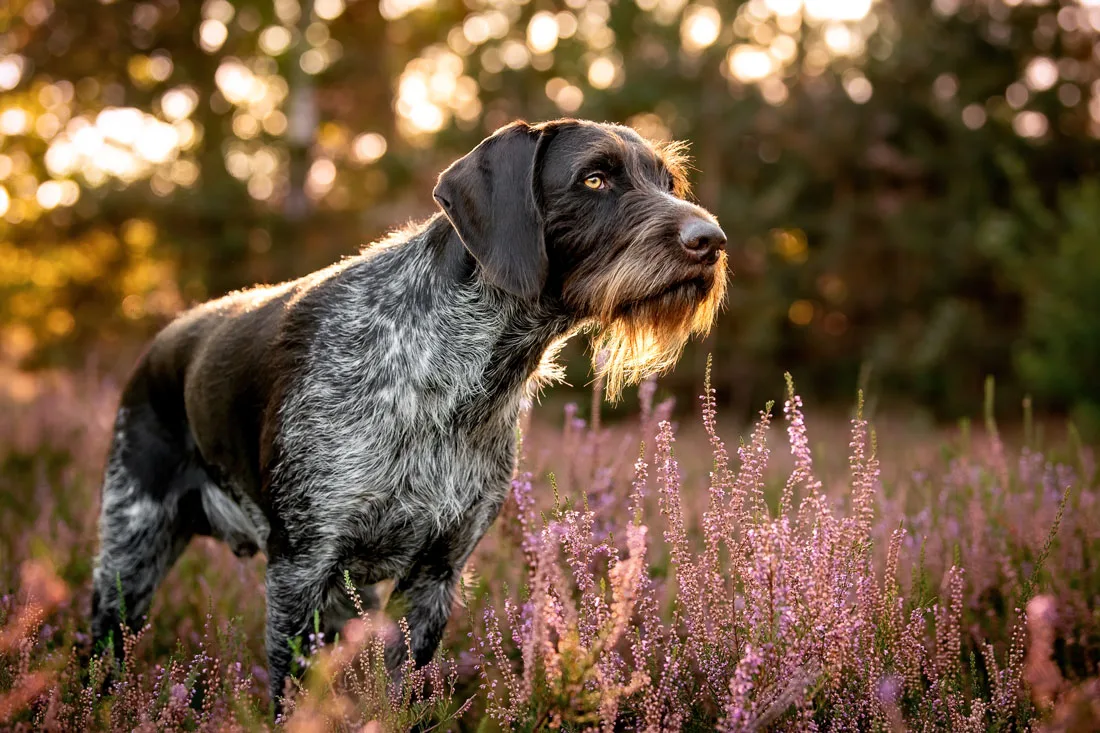
The German wirehaired pointer is a medium-size dog with a muscular build, harsh wirehaired coat and distinctive beard and moustache. In general, the GWP is slightly bigger-boned than the GSP. There is a certain amount of variation in the overall look from one line to another, especially between dogs bred in the VDD system and some of the dogs selected for field trials in the US. GWPs are generally between 60 and 70 pounds, with some males weighing up to 85 pounds and some females closer to 50. Males range in height from 24 to 26 inches at the shoulder, and females should not be shorter than 22 inches.
COAT
The ideal GWP coat consists of a harsh, flat-lying, 2cm-to-4cm outer coat that serves well in thick cover, repelling briars and thorns, and a dense, water-resistant undercoat that helps the dog stay dry and warm. The moustache, beard and eyebrows, collectively called furnishings, tend to be shorter on GWPs than on griffons or Spinones.
In North America most German wirehaired pointers are brown roan, but lighter-colored coats are fairly common. In fact, an almost-all-white coat is popular among some field-trial breeders. The AKC standard for the GWP states that: “Any black in the coat is to be severely penalized.” However, because coat color is judged only in the show ring, some breeders simply ignore the sanction and run black roan dogs in field events such as those put on by NAVHDA.
IN THE FIELD
GWPs typically display an energetic, close- to medium-range search. They generally hunt at a medium gallop—not quite as fast as the average GSP but faster than most other German pointing breeds.
Jeff Jalbert, a GWP breeder who has judged hundreds of dogs and taken many of his own to the highest levels of NAVHDA tests, told me that the breed’s typical range is 75 to 100 yards but that the cover the dogs are working through plays a key role.
“If you are a hardcore hunter who likes to hunt new areas,” Jalbert said, “you want a dog that can cover a lot of ground, as long as the dog is biddable and honest. When we hunt open grasslands, I expect my dogs to be out there at 100, 200 or even 300 yards. But later when we hunt tight cover, the dogs will tighten up and work much closer. And a well-bred GWP will always adapt to the conditions.”
Anthony Williams, an avid hunter and falconer who has had GWPs for more than 30 years, agrees. “I want a dog with a strong prey drive,” he said, “but I also want that drive to be manageable. I hunt pheasants, ducks, geese, rabbits and other fur-bearing animals, so I need dogs that naturally adjust their range and speed to the terrain and game I am hunting.”
GWPs generally have a strong pointing instinct that develops early. Pointing styles vary from a typically Continental level-tail stance to a more Americanized high-head, high-tail posture.
Jalbert estimates that up to 50 percent of GWPs will naturally back another dog’s point. “I like a dog that backs naturally, with a lot of intensity and style,” he said. “It is actually one of the traits I select for.”
RETRIEVING
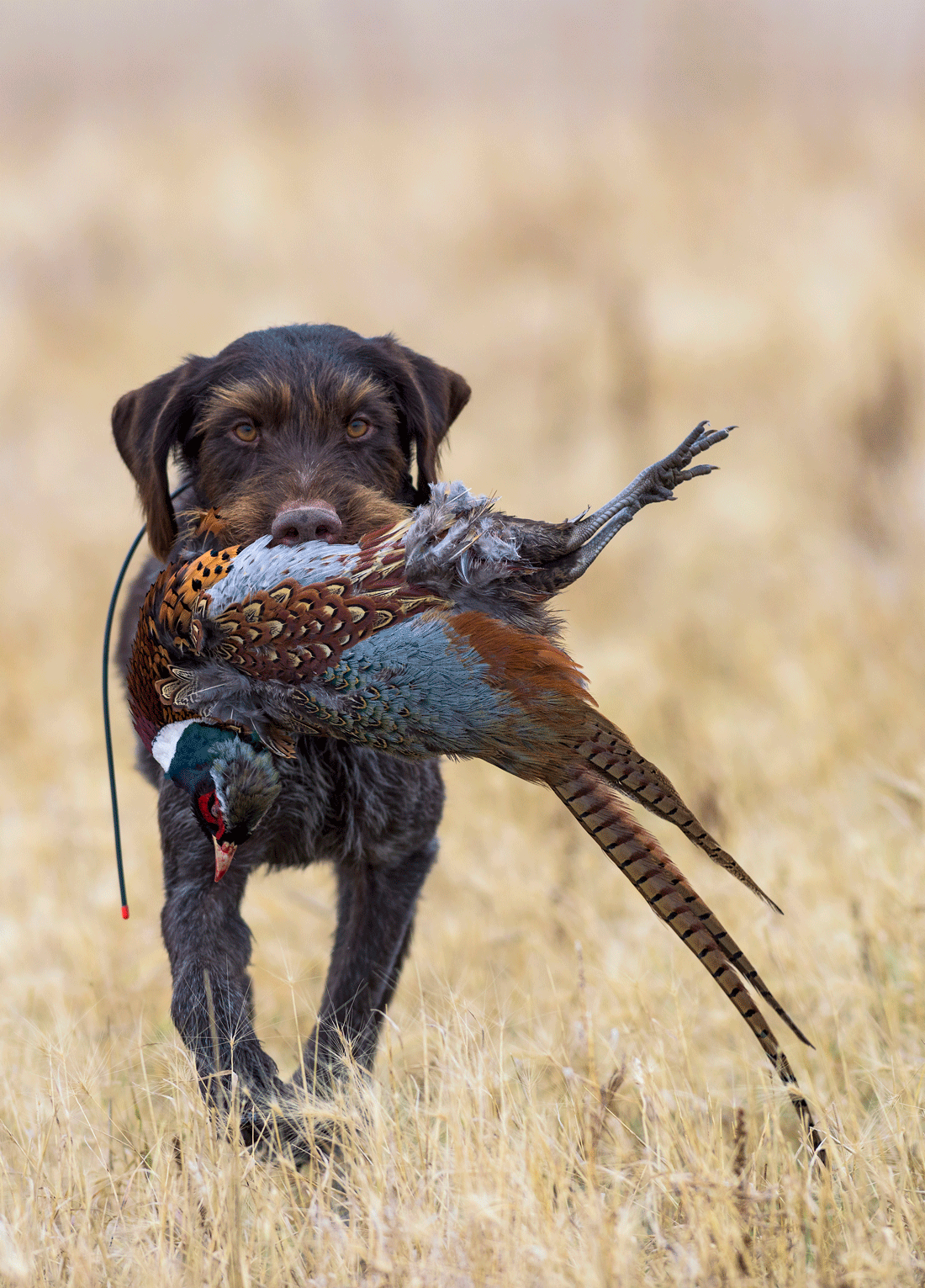
When it comes to retrieving, GWPs are arguably the best among the versatile breeds. In most pups, the retrieving instinct is there from the get-go and only needs to be channeled by trainers to develop first-rate retrievers. Hard-mouth has been reported in some lines, but it is not considered to be widespread.
WATER WORK
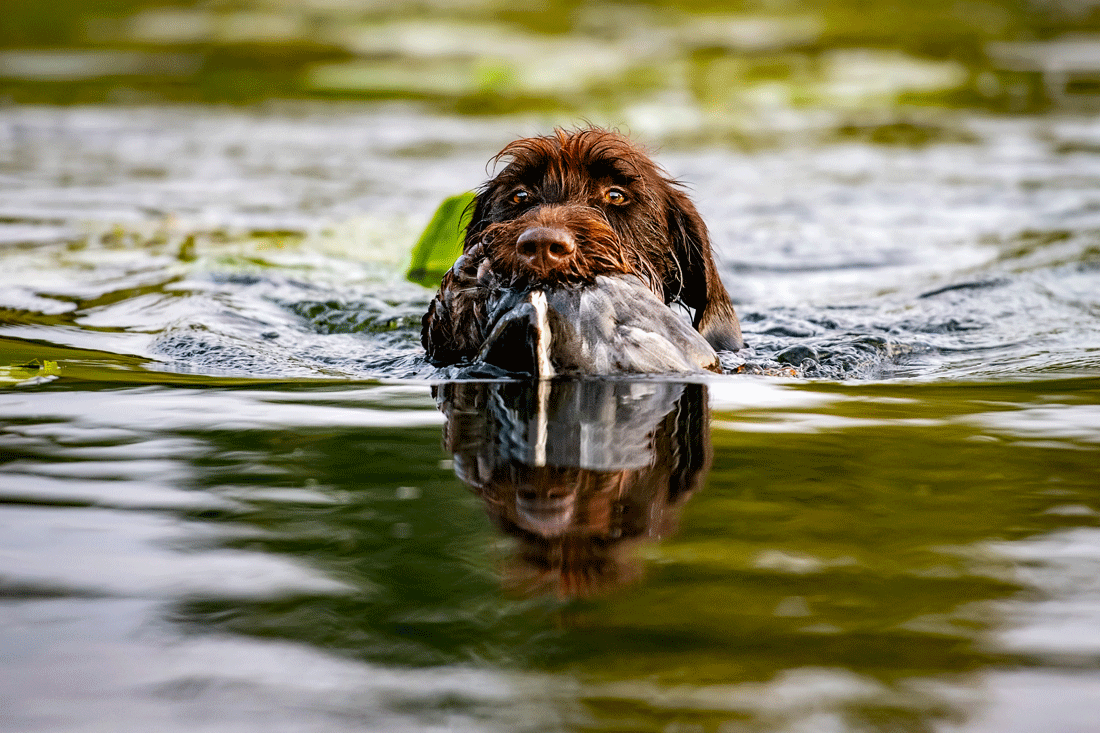
Among the versatile breeds, the GWP is arguably the best choice for waterfowlers. While the breed may not be the equal of a Labrador or Chesapeake Bay retriever for late-season duck hunting on big water, its intense retrieving instinct, strong prey drive and protective coat enable it to work the toughest wetlands.
TRACKING
Within the VDD testing and breeding system, a great deal of emphasis is placed on selecting dogs for a strong natural ability to track on land and in water. In addition, there is an increasing tendency in Germany to select for dogs that give voice on trail. In contrast, breeders outside the VDD system tend to place tracking abilities lower down the list of priorities. But that is not to say they ignore them altogether.
According to Jeff Jalbert: “There is nothing better than seeing a dog track a wounded pheasant in thick, tall grass and then reappear hundreds of yards away with the bird in its mouth. And with more and more states now allowing blood tracking, a lot more folks are using their dogs to track wounded big game.”
TEMPERAMENT
In private conversation, some breeders may admit that in the past some GWPs were too intense, even aggressive. But they also will be quick to point out that in the past 30 years much progress has been made in eliminating aggressive tendencies in the breed. Still, the reputation hangs on in some circles. Personally, I have never met a GWP that I considered aggressive toward people or other dogs. Of course, none has been a shrinking violet either.
There is also some variability in the level of “sharpness”—the willingness and ability to take on predators like foxes, raccoons, porcupines and even coyotes—in various lines and individual dogs. With some dogs, you need to exercise caution around household cats or chickens. Nevertheless, the vast majority of today’s GWPs possess a well-balanced character suited to the job they are bred to do.
When I asked Anthony Williams about the breed’s temperament, he said, “They are strong dogs, physically and mentally. But for the active outdoors person who loves hunting, fishing and hiking, they are the ultimate do-it-all hunting companion.”
Jeff Jalbert agrees: “Wirehairs don’t do well sitting in front of the fire for days on end. They need exercise, and they need to do what they are bred for. But they do make wonderful companions. Sure, you absolutely can find dogs that are too intense for the average person. And you can find some that are aloof or wary of strangers, but they are not common. I pride myself on breeding dogs that are mentally stable, with a solid ‘off’ switch. I’ve seen some outstanding shorthairs, Pudelpointers and griffs. But the cold gets to shorthairs, and the griff and Pudelpointer gene pools just don’t have the same level of coat stability. So for me, GWPs are the best bird hunting partners and house companions you could ever want. Just make sure to get one from a reputable breeder who runs all the necessary health and performance tests.”
A STRANGE SPLIT
About a decade after the German Wirehaired Pointer Club of America was formed, a small-but-dedicated group of GWP enthusiasts took steps to establish a new club in the US. However, unlike the GWPCA, which used the breed’s English name and entered dogs in American-style field trials and conformation events, the new group intended to stick with the breed’s German name, the Deutsch Drahthaar (DD), and register, test and breed their dogs through the parent club in Germany. In August 1971 the group’s efforts paid off when Group North America (GNA) was officially accepted as a chapter of the Verein Deutsch-Drahthaar club of Germany. A similar group formed in Canada in 1974 and was officially recognized as a chapter of the German club in 1984.
Today GNA has eight chapters across the US and has a membership of more than 1,500. Every year the club hosts three levels of field and water tests as well as coat and conformation evaluations, in accordance with the rules and regulations established by the parent club in Germany. When talking about their dogs, members usually refer to them as Drahthaars instead of wirehairs. And while the difference in breed names may seem trivial, for anyone interested in getting a puppy, the differences between the two camps’ approaches to testing, breeding and registration are among the most important things to consider.
It is beyond the scope of this article to delve into the differences between the two camps, but here are some key points to keep in mind.
To members of the VDD, the term Drahthaar applies only to dogs that are registered with the VDD; produced by a sire and dam registered with the club; and descended from generations of dogs that have met all the performance, conformation and health-test requirements of the club. As a result, the dogs tend to have a specific look and hunting style.
Some folks outside the VDD may also use the term Drahthaar, but most call their dogs German wirehaired pointers; and since organizations like the AKC, NAVHDA and United Kennel Club have such varied approaches to evaluating and breeding dogs, the term GWP applies to a much broader range of dogs.
A breeder focused on the AKC show ring may have vastly different priorities than one aiming for top honors in NAVHDA or winning the GWPCA national championship. As a result, even though GWPs and DDs come from the same genetic root source, there are many “types” of GWPs out there. They run the gamut from almost identical to DDs to dogs closer to American field-trial German shorthairs in looks and hunting style. There are even GWPs that come from lines that have not been proven in the field and may or may not have the abilities most hunters desire.
But no matter what you call them—German wirehaired pointers or Deutsch Drahthaars—a well-bred dog from either camp will have enough horsepower for just about any kind of hunting you do. For hunters who value speed, range and point above all, a dog from a GWP breeder who focuses on field trials may fit the bill. For hunters who want an all-around dog bred within the North American system, they can look for a dog from a NAVHDA-affiliate breeder or a breeder who tests with the Versatile Hunting Dog Federation. For hunters who value the structure of a time-tested, highly regulated club, the DD community would be a great fit, especially if they pursue fur and feather.
Is the GWP/DD the ultimate do-it-all gundog in the field, forest, water and home? For thousands of hunters around the world, the answer is yes. Is it the right breed for you? Only you can answer that question. But if you are looking for a talented, versatile gundog that you can also enjoy as a companion during the off-season, then the GWP/DD needs to be near the top of your list of breeds to consider.
Read our Newsletter
Stay connected to the best of wingshooting & fine guns with additional free content, special offers and promotions.
