From our January/February 2026 Issue
One of the uniformed employees at the upscale shooting club was cleaning an over/under shotgun. I asked if it was one of the rental guns.
“No, it’s a customer’s gun,” he said. “Don’t they clean guns for you at your club?”
As a matter of fact, no, they don’t clean guns for us at my club. We take our guns home and clean them on a bench in the basement just like everybody else.
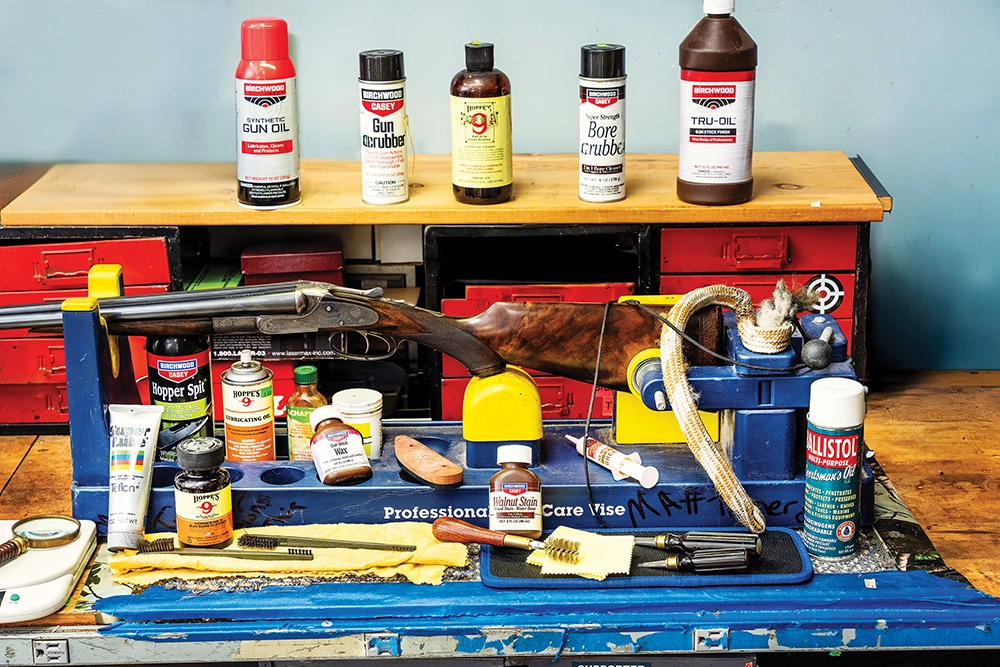
A shooter’s bench is a necessity (unless you belong to certain clubs, apparently), because regular attention keeps guns working and looking good. It extends their life too. Setting up a dedicated shooting bench with all the supplies you need makes gun care easier and almost enjoyable.
Your bench should be sturdy. Mine was given to me by a woodworking friend who was done with it. It is homemade and overbuilt out of two-by-fours butcher-block-style. It weighs a ton and does not wiggle in the least, which is important. The bench also needs to be in a clean, lighted corner of a room where you can easily find small gun parts when you drop them. This is also important, and I have learned and re-learned this lesson too many times.
You’ll want a mat for the bench top. I have a cheap one that came with a gun-cleaning kit, but I’d like to upgrade to the Real Avid Smart Mat. The Universal model is 43 inches long, so almost the full length of a shotgun. It’s oil resistant, it rolls up neatly when it’s not needed and it has a clever parts tray with some of the compartments magnetized to prevent springs and pins from escaping.
A gun cradle holds the gun securely upright so you can perform jobs that might otherwise require three hands. Mine is a Tipton Best Gun Vise, which holds guns securely without marring and adjusts to accommodate any-size gun, including a handgun. I can also put barrels in it for cleaning.
If you plan to do any kind of repair that involves holding a gun very securely, an actual vise comes in handy for jobs that require torque and elbow grease. Removing stubborn choke tubes, for example, is more easily done when you can clamp the gun firmly in a vise. Vises aren’t cheap, but they’re better than clamping guns between your knees. Real Avid’s Master Gun Vise is all-steel. It bolts securely to your bench and rotates on a ball socket so you can get your gun from any angle, and its padded jaws hold the gun gently but firmly.
Along with mats, vises and cradles to hold your gun, you will need certain tools and cleaners, such as the following.
TOOLS
- A Phillips-head screwdriver for removing recoil-pad screws.
- A large, long flathead screwdriver for stock bolts.
- A socket set with an extension for removing unslotted stock bolts, some of which may be metric.
- A set of jeweler’s screwdrivers, both flathead and Phillips.
- A hammer with nylon and brass heads for tapping things gently.
- Roll-pin punches, mostly essential for popping trigger-group pins and small pins inside semi-autos and pumpguns.
(A nylon/brass hammer, and steel, brass and plastic punches can be bought at once in the oxymoronically named but very useful Birchwood Casey Weekender Professional Gunsmithing Kit.) - A strap wrench for removing stuck magazine caps without marring them—especially if you own a Beretta 391.
- You need to have the right-size screwdrivers to have any hope of removing screws without marring them. I have an older version of the Wheeler Engineering 100 piece Professional Screwdriver Set. It comes with two handles and bits of all sizes, and it keeps me out of trouble when I decide to take a gun apart. You can also buy a version that includes a torque wrench that is handy for tightening stock bolts to the proper degree.
- Choke-tube wrenches in all the relevant gauges belong on a bench. Much as I like the kind with fishing-reel handles for day-to-day, sometimes you need a wrench you can grab with pliers for extra leverage.
- Murray’s Gunsmithing’s Vent-Rib Tool is a handy little fixture that clamps onto the rib and can pull many—though not all—dented ribs back into shape. And it won’t mar the matting.
- A Kleinendorst Sling Swivel Drill Fixture is on my wishlist. I have a much cheaper fixture that worked well until I figured out how to screw up with it and set a couple of swivel studs off-center and/or at angles. Much as I want one of these, it’s hard to justify the $250 price tag when it doesn’t cost much to pay a gunsmith to do this job for me.
CLEANING & LUBRICATING SUPPLIES
- Cleaning rods with phosphor-bronze brushes and mops in all relevant gauges are a cleaning-bench mainstay. It’s good to have brushes on gauge up to use as chamber brushes too.
- Bore snakes are great for when I feel too lazy to use the cleaning rods.
- A nylon brush gets a lot of gunk out of guns. It can be an old toothbrush, although I have several double-ended brushes with no identifying marks on them beyond “Made in Korea” and they work fine. I have one with copper bristles, too, for tougher jobs.
- An aerosol can of compressed air is unbeatable for blowing bits of field debris out of shotgun actions. When that doesn’t work, plastic dental picks do.
- Cotton pads are indispensable for cleaning bores and other chores. Currently I am going through a pack of 3" x 3" Outers pads, which are a useful size.
- Q-tips make handy cleaning tools too.
- Rags made of old T-shirts are, of course, a mainstay of any gun-cleaning bench.
- Shooter’s Choice is my pick for greasing whatever needs to be greased, such as hinge pins, trunnions, knuckles, magazine-cap threads and choke-tube threads.
- Loctite Threadlocker Blue secures loose beads and other screws that have to stay put but that may need to come out again someday. Loctite Threadlocker Red puts them in practically forever, so use it wisely and rarely.
- Maybe I should be picky about oil, because so many people have strong opinions, but Rem Oil in an aerosol can works fine for me.
- A bottle of Break Free CLP comes in handy often.
- Hoppe’s No. 9 smells right and cleans bores just as well as it always has. It comes in bottles and as a foaming bore cleaner. The foam is nice, because you spray it in, do something else for 15 to 30 minutes as the foam settles, and then wipe it out.
- Renaissance Wax Polish protects and enhances both metal and wood, although it’s primarily known for giving new life to gunstocks.
- Birchwood Casey Tru-Oil Gun Stock Finish works for total refinishes, which are far beyond my level of competence and patience, and for touching up oil finishes, which I can manage.
The tools and supplies listed here are enough to keep your guns well maintained and to perform a few simple repairs. If you’re competent and confident in your abilities, there’s no limit to the additions you can make to your shooter’s workbench. The Brownells website will sell you all manner of files, checkering tools and even taps and reamers to install choke tubes in your barrels. I will leave such tasks to the skilled and brave. Me, I long ago learned that once I get beyond gun cleaning, the most important tool I own is the phone on which I’ve saved my gunsmith’s number.
Read our Newsletter
Stay connected to the best of wingshooting & fine guns with additional free content, special offers and promotions.