From the Novermber/December 2026 Issue
Ned, then in his late 70s, was the youngest member of his Texas Panhandle goose hunting gang. As a group, they had a hard time sitting up out of their layout blinds when it came time to “take ’em.” Retired engineer Ned found the solution: He put Ab Rockets, those spring-loaded core-exercisers (he called them “A-B Rockets”) in every blind. Spring-assisted, Ned’s octogenarian crew popped out of the blinds like finished toast when he called the shot.
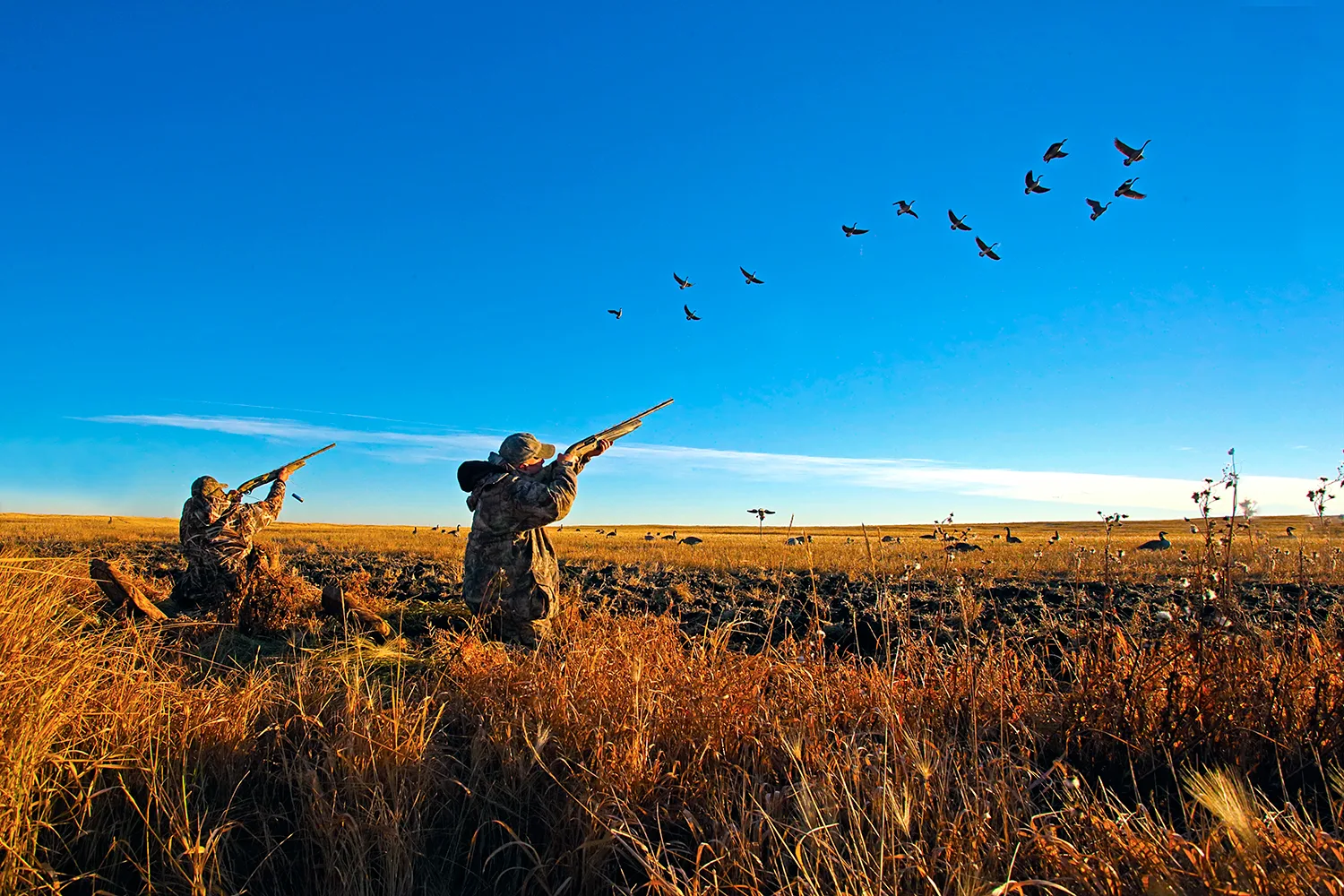
“Get up fast, then take your time” is the first rule of goose shooting. Whether spring-aided or not, sit or stand up in a hurry and take it all in. After that, pick a bird and get to work.
Shooting geese shouldn’t be hard. A 13-pound giant Canada makes a huge target. And yet, we have all emptied our guns at geese, disbelief growing with each pull of the trigger, until the shells—and the birds—are gone. I can’t guarantee you will never miss a goose again, because I am about to tell you most of what I know about goose shooting, yet I am still shaking my head over a decoying bird I whiffed on three times last year. Trust me anyway and read on.
Layouts
The need to hide from geese in a layout, a pit or an A-frame complicates a simple shooting task. Layouts are the toughest to shoot from. The shooting motion begins with performing a sit-up. Once you’re up, your range of motion is limited on your dominant-hand side.
Failing Ned’s A-B Rocket, you can make the sitting-up part of layout hunting easier if you dig a depression for your feet or for your seat beneath the blind. Digging down a few inches below the boot bag gives your heels more purchase as you sit up. An indentation below your seat is even better. Between the hollow you scoop out for your backside and the backrest you’re resting against, you’ll already be much of the way up.
Angle your blind so it’s pointing 30° to 40° to the right (if you’re right-handed) of your most-likely shot. When you shoot sitting, your natural point of aim will be to your left, and your upper body can turn a long way in that direction. If you think in terms of the 10:00-to-2:00 shooting window (if you’re in a group), that means you should, as a right-hander, set yourself up for the 2:00 angle, because you’ll have an easy time swinging to 10:00 but a hard time getting past 3:00 going the other way.
With most layouts, the doors will flop out of your way as you sit up. Some blinds have stiffer doors. Those you will have to fling open. I’ve found it’s easiest for me to sit up first, and then mount the gun.
Pits and A-frames
Pits are not my favorite, and I didn’t like them even before the afternoon on Colorado’s Front Range when I dropped a pit lid in my lap as 200 cacklers hung cupped over the decoys. I have seen birds flare hard, but never quite as hard as that bunch flared.
The problem with pits is that, if you’re not the one calling the shot, you’re in the dark, in a hole in the ground with a lid over your head, unable to watch what’s going on topside. Watching birds work is 90% of the fun of waterfowling, but that aside, you’re at a disadvantage at go time if you can’t watch the birds come in. A good shot-caller gives a running commentary until you throw the lids open, so you have an idea where the birds are and how many to expect. While not as much fun as watching, listening to the pit boss’s play-by-play is undeniably exciting. It can get you too wound up to shoot well too. Use some self-talk as the birds are working. Tell yourself to slow down and pick a bird.
Before the boss says, “Shoot ’em!” make sure you have your gun in both hands but still safely pointed up. While guides may be deaf from years of hunting, they can still hear the click of a safety snapping off too soon, and they hate that. Leave the safety on, do whatever you have to do to open the lid, and stand up fast. Bring your gun up to a ready position—butt lightly under your arm, muzzle angled up so as not to endanger a retriever breaking prematurely—and look around for a bird to shoot. You have the element of surprise on your side. If geese have committed to landing in the decoys, they are not expecting several people with guns to pop out of the ground. There is time to pick a target.
Shooting from an A-frame is like shooting from a pit, except without the dirt falling down the back of your neck. Sometimes you can see a little bit too. Wear a facemask in an A-frame if you, like me, can’t stop yourself from peeking as the birds come in. I want to be able to watch the show without ruining the hunt for everyone else by scaring the geese away.
Shooting
Here is a fun fact about Canada geese: The head of a giant Canada is almost the same size as an entire mourning dove. I know this and still have a hard time focusing on the head as I should. Instead, too often I get excited and shoot my geese center mass. This is lethal to the geese, if hazardous to my dentition at dinner when I may have to eat around large pellets in the breast and legs. What I try to do is pick a bird, and then look at the cheek patch if it’s that kind of goose or the bill of a snow or speck. Geese are big birds, but they are not hard to kill if you shoot them in the head.
Shots at geese will come either over the decoys—in which case you just get up, make a smooth and unrushed mount and shoot—or sometimes over the top. The over-the-top shot is the one time I will swing through a goose from behind and blot it out with the barrel, shooting as the muzzle passes the head. The higher the bird, the slower you should swing the gun.
In some pits and in all A-frames, it’s possible to take shots behind the blind as long as the footing is firm. I will ask if it’s OK first, rather than spinning around unannounced. Turning safely means holding the muzzle straight up in the air until you’ve gotten all the way around. After that, it’s a regular shot, just in the other direction.
As for doubles or even triples, I never plan for them, as some do. I will shoot more than one bird when the opportunity presents itself, though. It matters more to me that the first bird folds up dead, so I’ll watch it fall for an instant, and then look for another if there’s time.
Hardware
I have shot geese with 20s, with 3½" 12s and with 10-gauges, but my favorite goose load remains the 3", 12-gauge load of 1¼-ounces of steel BBs. With that load through a Modified choke from the Benelli Montefeltro or Browning B-80 I favor for geese, I can cleanly kill birds at 40 yards or a couple of wingbeats farther. Steel No. 2 duck loads work fine on the honkers that drop into my mallard spread, although I am fond of BBx2 stacked loads when I don’t know if I’ll be shooting ducks or geese. Bigger steel sizes—BBB and T—are best saved for long-range shooting. In bismuth, I like No. 2s or 3s over decoys. In HEVI-Shot, I’ll shoot 4s. I am a big fan of shells that include a pinch of TSS with a payload of steel for mixed bags of ducks and geese. BBx7 steel/TSS is my favorite combination in a mixed stacked load.
Smallbore shooters, of whom there are more every year, and small-shot fans do best when they let geese come close and shoot them in the head. But then, we all do better when they’re close. We are lucky that way. For our parents or grandparents, geese were rare birds. Hunting them usually meant pass-shooting with the biggest guns at the longest ranges, either from a pit around a refuge or from a hide in a ditch on a flightline. With specks, snows and Canadas booming, we have the luxury of luring them into the kill hole, and then springing up—literally, if you’re Ned—and taking an instant to look them in the eye before the shooting starts.
Read our Newsletter
Stay connected to the best of wingshooting & fine guns with additional free content, special offers and promotions.