From our July/August 2026 issue
While hunting last fall, a friend took a shot to the head. The flattened pellet removed from his forehead appeared to be a lead No. 6.
The errant, unsafe shot was fired at a pheasant by a hunter blocking at the end of the field. Luckily, the recipient of the peppering was wearing shooting glasses and a facemask on that cold day, or the accident could have been much worse than pellet extraction and a follow-up trip to the plastic surgeon.
What went wrong? Just about everything.
A low shot that never should have been taken? Definitely.
An inexperienced or excited hunter with tunnel vision? Likely.
Poor communication and a bird sandwiched between driver and blocker? Absolutely.
While most readers of this magazine have likely mastered the art of hunting and shooting safely, it pays to remain vigilant—especially when hunting with friends, over dogs or among strangers who may be less experienced or unsafe. And it takes only an instant or one bad habit to create an opportunity for a shooting accident in the field.
Mark Haglin and his son Morgan of Pine Shadows kennel and training facility, in Brainerd, Minnesota, have spent decades teaching proper firearms safety while hunting, guiding and shooting safely at field trials. Pine Shadows specializes in training and breeding English springer spaniels, and Morgan is the head trainer and a respected firearms-safety instructor.
The Haglins emphasize the basic commandments of firearms safety, which include:
• Treat every gun as if it’s loaded.
• Always point the muzzle in a safe direction.
• Keep your finger off the trigger until you’re ready to shoot.
• Never point your gun at anything you do not intend to shoot.
• Be sure of your target and what is beyond it.
“Those serve as a great foundation and stand the test of time,” Mark said. “In addition, we always make it a point to talk to our hunters about ‘field of fire,’ ‘court vision’ and taking shots at 10 o’clock or higher.”
The dictionary defines field of fire as the area around a weapon that can be easily and effectively reached by projectiles from a given position. “Field of fire is the angle left and right that you can safely shoot,” Mark said. “When you’re in the field, those angles change with every step you and your hunting partners take. It may only be a slight change, but that’s often the difference between a safe or unsafe shot.” Field of fire applies whether you’re hunting pheasants on the prairies, grouse in a tag alder thicket or quail on a Southern plantation.
“Think shooting lanes and the safety zone,” Morgan said. “If a bird flies out of that safe field of fire or shooting lane, let it fly away. That’s a hard line you don’t cross.”
Court vision means situational awareness and seeing the big picture. Like the point guard in basketball—always aware of where teammates are, directing traffic, calling the play and anticipating the next move.
According to Mark: “In bird hunting, court vision means knowing where other hunters and dogs are, where the bird might fly and what other factors might come into play—like the terrain, the wind and the weather.”
The enemy of court vision is tunnel vision. “We call that ‘target focus,’” Morgan said. “People get excited or in a hurry and only see the bird. Everything else is a blur. Target focus works in sporting clays or trap and skeet, but not in a hunting or field-trial situation.”
Morgan, who conducts gunning seminars and serves on the national guns team for AKC springer and cocker field trials, said that field trials present myriad other safety considerations. “You have the contestants, the dogs, the bird planter out front, the gallery behind, people coming in and out of the field from the parking area, other gunners and the judges,” he said. “There’s a lot going on, so court vision and field of fire really come into play. At the same time, gunners at a field trial are there to shoot for the dog. That means shooting the bird at the most advantageous spot for the dog. With sporting clays, you’re shooting the claybird at the most advantageous spot for you.”
Mark adds that gunners at a field trial must always check field of fire before and after the bird flushes, “meaning you need to take your eyes off the bird, check your drop zone or where you want to drop the bird, and go back to pick up the bird and make your shot.”
Gunners at spaniel field trials also break open their guns every time they stop or there’s a pause in the action while being mindful to always turn away from dogs or people when loading or unloading. Hunters should follow the same example—especially when crossing fences or taking a break.
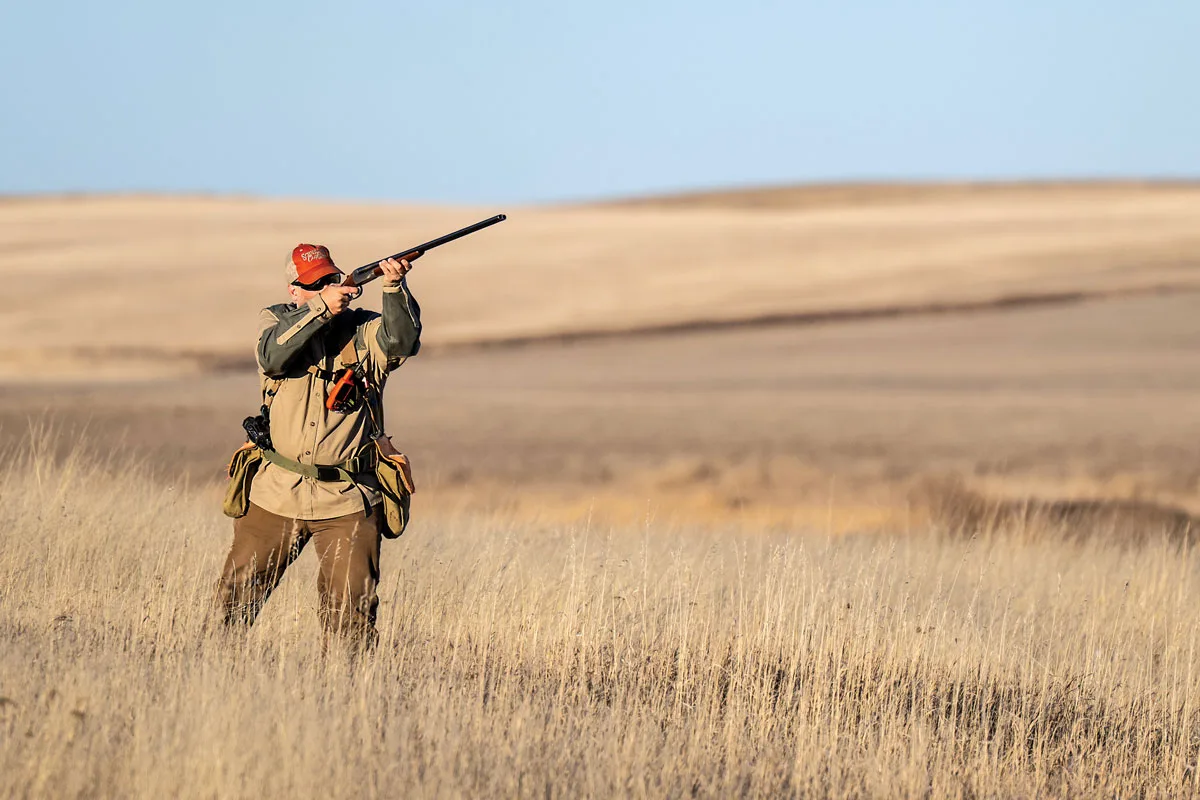
The “10 o’clock-or-higher rule”—meaning no low shots—is always in play. Think of a clock on its side. A gun pointed at high noon would be straight up in the air, while a gun pointed at 9 o’clock would be parallel to the ground. Aim for 10 o’clock or higher.
“That means waiting for the bird to get high enough and away from a dog that might leap,” Mark said. “That means approaching a dog on point with the gun up and the safety on. If the bird flushes behind you or flies straight back, that means turning around is always a muzzle-up, safety-on situation as you turn—not a sweeping motion with your gun trying to track the bird.”
Field-trial birds don’t always fly well. And wild birds, by definition, are unpredictable. “Woodcock, in particular, are very erratic,” said Morgan, who served many years as a huntsman at the Ruffed Grouse Society’s annual National Grouse and Woodcock Hunt. “Woodcock spiral through heavy cover and often pop up and go low quickly. You have to be hardcore and disciplined to wait until they clear the canopy to take that shot. If they go low, you don’t take the shot. Make it a habit to only take the good shots.”
Morgan adds that he’s a big fan of vivid Blaze Orange—not only at field trials, where it’s mandatory, but also while hunting, no matter what game you’re pursuing. “A lot of hunters have that favorite faded old orange hunting cap,” he said. “Why not wear as much Blaze Orange as you can in the grouse woods—or wherever you hunt? Every year I get a new orange hat, because it stands out. Every few years I get a new vest. I want people to see me. Court vision!”
In addition to Pine Shadows, the Haglins operate Daybreak, a 6,000-acre hunting property and lodge near Frederick, South Dakota. “We give the same four-minute safety talk every day to every hunter,” Morgan said. “It doesn’t matter if they’ve been coming to the property for 15 years or it’s their first visit.”
The Haglins reinforce “muzzle awareness” at all times. A safety pet peeve involves hunters who carry their guns on their shoulders pointed backward and parallel to the ground. “When they get to the end of the field, turning and talking to one another, that barrel is pointing at everyone but them,” Mark said. “Likewise, people need to know how to close a break-open shotgun so they’re not pointing the barrels at a dog or a person.”
One concern of Morgan’s is the trail carry, or military carry, of a shotgun. Some hunters have a habit of carrying their gun at their side—pointed down or parallel to the ground. “Keep that gun up and pointed away from people or dogs,” Morgan said. “Watch that muzzle. We often see unsafe behavior when people get in a hurry. Maybe it’s hunters rushing to get up to a dog for a shot. Then there’s the excitement of multiple flushes. Sometimes we even see people competing to see who can shoot the most birds. That’s when we need to slow things down. Take a minute to address any bad habits and reinforce safe behavior. Do that, and you’re good to go.”
Keith Schopp is a freelance journalist and retired communications executive with a passion for sporting dogs and conservation. Based in southern Illinois and North Dakota, Schopp enjoys following his Labrador retrievers and German shorthaired pointers wherever gamebirds can be found.
Read our Newsletter
Stay connected to the best of wingshooting & fine guns with additional free content, special offers and promotions.