

From our November/December 2026 issue
Beretta’s SO (Sovrapposto) shotguns are some of the most influential over/unders ever made. They are emblematic of the progressive and inventive Italian fine-gun trade in general and its oldest representative in particular. (Let’s not forget that this year Beretta turns 500!)
All manner of claims have been made on behalf of Beretta’s SOs: that they were the first modern Italian over/under; that their success inspired the migration of Italy’s fine-gun trade from the Emilia-Romagna region to the Val Trompia; and, as firearms expert Marco S. Scipioni has argued, that they “signaled an important turning point in the history of the modern Italian gunmaking industry.”
To appreciate the SO’s undeniable success, the context in which it first appeared needs to be understood. Both London’s Boss & Co. and James Woodward & Sons had previously offered fine O/Us, but those hallowed handmade indulgences were only affordable to the upper crust. In 1931 (two years after the start of the Great Depression) Browning introduced a low-cost ($107) O/U called the Superposed, which immediately found an international market.
World War I had fundamentally altered Europe’s social fabric. The aristocracy, traditionally patrons of fine-gun makers, had been decimated and their shooting privileges curtailed. Live-pigeon shooting was being challenged by more egalitarian claybird shooting, and a new class of competition shooters was emerging who recognized the superiority of the over/under as opposed to the side-by-side. Browning’s Superposed serendipitously landed at the perfect confluence of demand and price point.
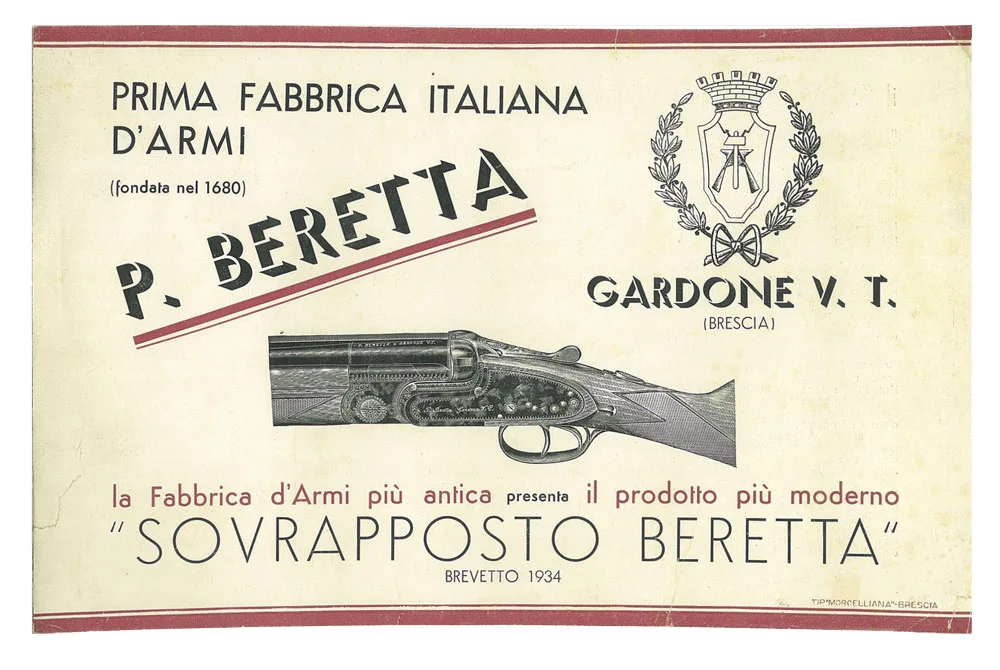
In the early 1930s Carlo Beretta, who was managing production and technical development for his father, Pietro, saw the potential for a shotgun to compete with the Superposed and tasked his head designer, Tullio Marengoni, with creating something better. According to R.L. Wilson, writing in his book The World of Beretta: An International Legend, Marengoni “had that rare genius found in only a few: the ability to invent firearms.” Given that Marengoni’s experience was limited to pistols and submachine guns, his mission was improbable; nevertheless, he chose to accept it.
Marengoni began by studying a range of extant O/Us and was “disgusted” by those made by Browning and German gunmaker Merkel because of the “height of the action body” and underbolt locking system—this according to Bruno G. Rüttimann, the principal authority on the Sovrapposto and author of The Beretta SO Over-and-Under—Collector’s Guide for Models of 1934–1987. On the other hand, Marengoni was impressed by Belgian models by Auguste Francotte and Lebeau-Courally, which featured shallow actions. Browning had rejected Belgian handcrafted O/Us as patterns for his own design because they “would not lend themselves to quantity production with modern machinery. Their mechanical design requires endless fitting and tinkering. Naturally, they have to sell at prices that put them beyond the reach of most men.”
Marengoni’s prototype was given Serial No. 2000 and appears in the Beretta register in 1933 as a “Tipo Lebeaux” (“type Lebeaux”). The following year, the gun Rüttimann considers the first Sovrapposto—because of the emergence of Beretta signature features such as “the characteristic visible trapezoidal lumps in the sidewalls”—was given Serial No. 2001. It was presented in the spring of 1934 at the 15th International Fair of Milan, or Fiera di Milano. Both the prototype and the “first” Sovrapposto now reside in Beretta’s private museum in Val Trompia.
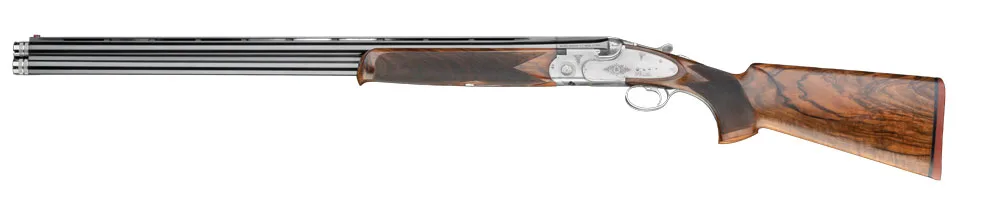
Marengoni’s design mounted the barrels low in the action with hinges alongside the lower barrel. Instead of the conventional side-by-side locking system beneath the barrels, Marengoni opted for modified Kersten-style top fasteners that extended from the monobloc’s breech into slots in the standing breech that were engaged by a traverse flat sliding bolt as the gun was closed. The result was a neat and shallow arrangement. And because these fasteners were forged as integral parts of the monobloc, the locking system was incredibly strong. The gun would require much fine fitting and filing, but this was a price Beretta was willing to pay for such elegance. Strength was dramatically enhanced by trapezoidal barrel shoulders that engaged cutouts in the action walls. These recoil shoulders were critical to the gun’s durability over time, and they also provided Beretta over/unders with an instantly recognizable signature feature.
Three models were initially available: the Modello S. 1 Super Caccia, the Modello S. 2 Super Caccia con ejettore and the Modello S. 3 Super Tiro ejettore. The first was a non-ejector intended for hunting, the second had ejectors and also was intended for hunting, and the third was a competition gun with ejectors intended to dovetail with Italy’s burgeoning passion for trap shooting.
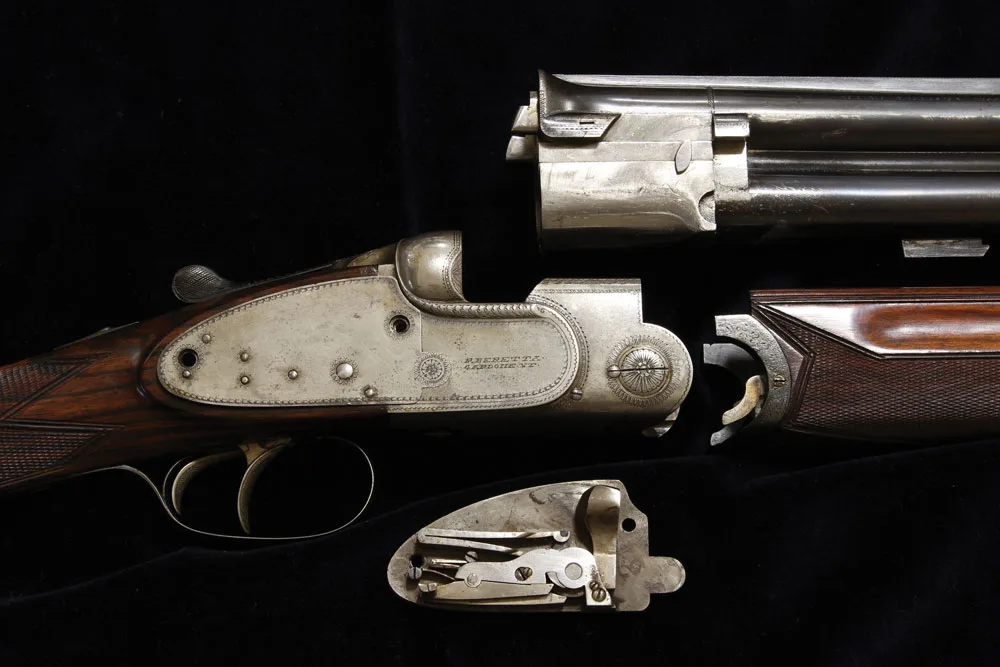
The “S” prefix stood for “Sovrapposto”—literally “Superposed” in Italian. Later catalogs added a “0” (zero) in front of each number designation, and later still the “0” became an “O” (uppercase O). One early catalog claimed: “a carefully studied gun, strong, well balanced and elegant, certainly superior to the dearest ‘superposes’ of any well-known foreign make” in an obvious dig at Browning. Intended from the get-go as “premium” models, the earliest SOs featured full sidelocks, which advertising literature touted as being of the Holland & Holland type.
Archived correspondence in the Beretta museum suggest that response to the Sovrapposto was immediate. Letters from Brooklyn, Seattle, Lisbon and São Paulo are supplemented by inquiries from Monte Carlo—then the capital of the live-pigeon-shooting world. Italian officers stationed in North Africa acquired Beretta over/unders to shoot guinea fowl and francolin and, according to Rüttimann, many of these guns were liberated by British and Commonwealth troops in the wake of the North African campaign of World War II.
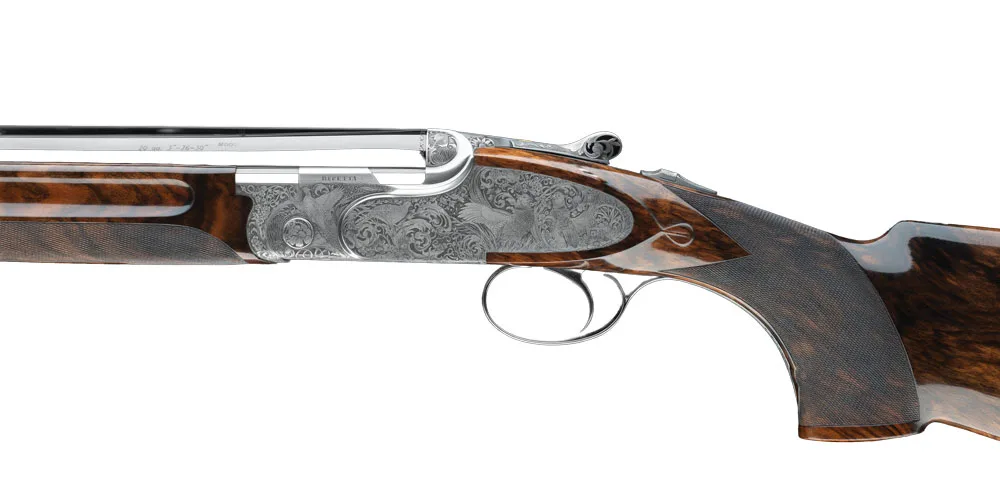
After WWII, demand for Sovrappostos increased, and Beretta added a higher-grade EL (signifying Extra Lusso, or “Extra Luxury”), which was later joined by even-more-sumptuous EELL grades. In 1956 the Sovrapposto’s future was secured by an Italian shooter named Galliano Rossini, who won a gold medal in trap at the Summer Olympics, in Melbourne, using an SO3 EELL.
In 1968 the Super Tiro was replaced by the SO4, a model specifically designed for trap, skeet and live-pigeon shooting, while the SO3 EELL continued in production. In the 1980s when sporting clays became popular in France, Belgium and Britain, Beretta was there to meet the demand. During that decade the SO2, 3 and 4 were discontinued and replaced by the SO5, 6 and 9. According to Rüttimann: “These had new action bodies that were slightly modified due to the introduction of an Express SSO [a double rifle], created for hunting the ‘Big Five’ in Africa . . . . In order to standardize production, the SO5 and the SO6 had the same reinforced receiver of the Express SSO6, adapted to withstand the pressure of the powerful .458 Winchester Magnum cartridge.” This new generation of SO series shotguns and rifles also featured the new Beretta sidelock, which was simpler and had quicker lock times than the previous generation. Hand-detachable locks were available on demand. The SO9 was the first in the series in small gauges, with svelte 20- and 28-bores available alongside a sleek .410. Models with an English straight hand were particularly graceful and have become serious collectibles.
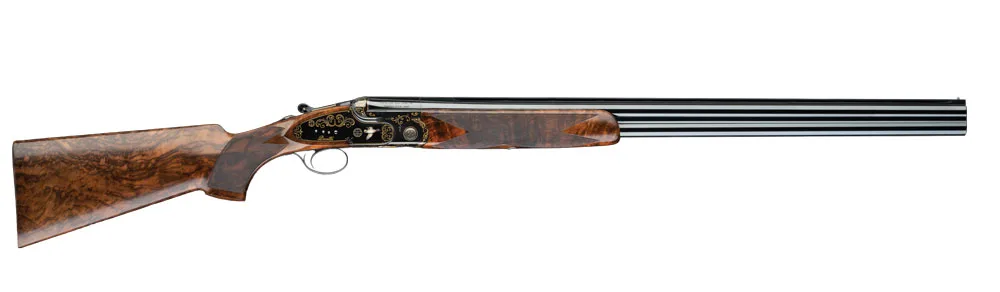
In 2004 Beretta introduced the SO10, which was redesigned to accommodate an entirely new lock-up system. The distinctive Kersten-style crossbolt was replaced by a rear longitudinal bolt operating in line with the hinge pins paired with two additional lower bolts for better strength. Pinless locks and a screwless action body gave Beretta’s master engravers a blank canvas—of which they took full advantage.
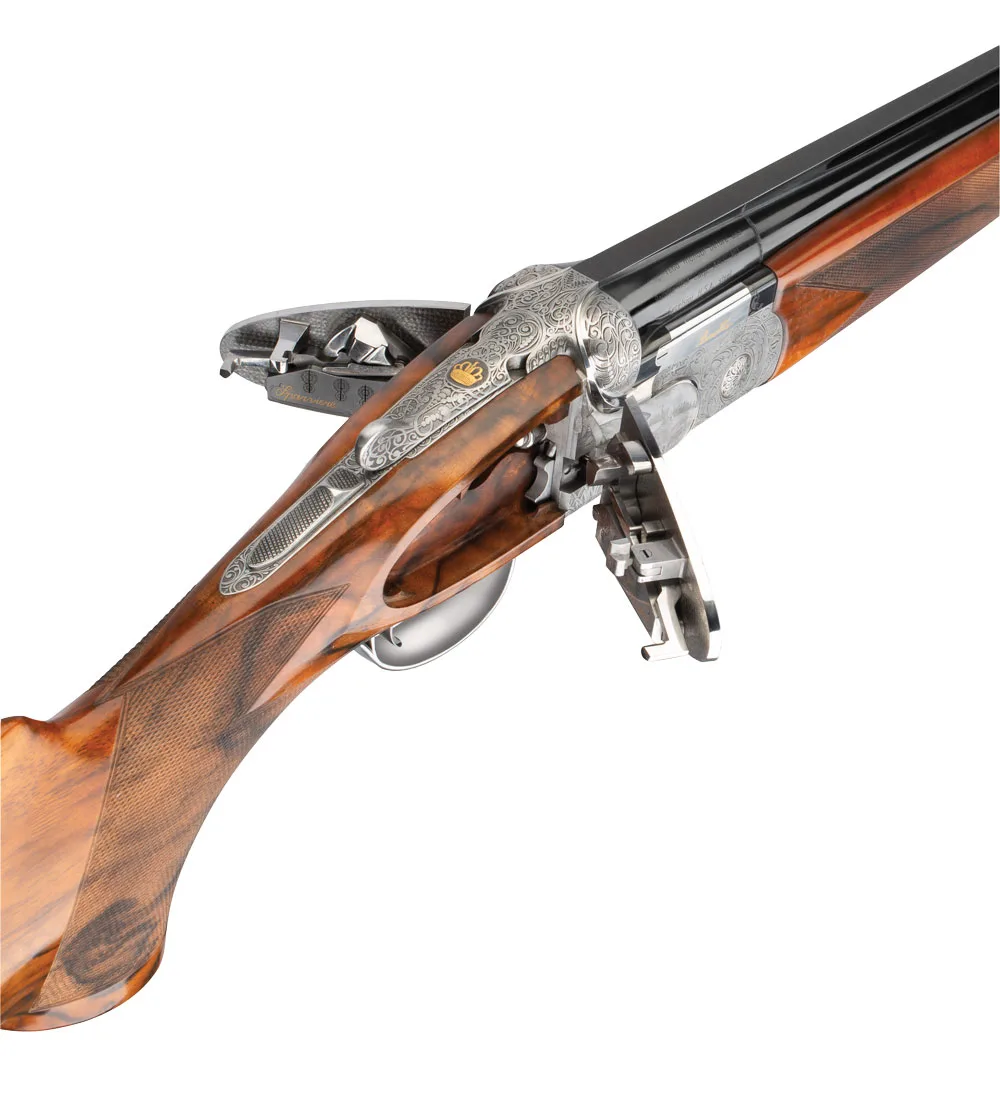
Today’s Beretta SO series guns are exceptional, but one particular variant, the Sparviere (introduced in 2014), is a standout. Built to the exacting standards of the other models, it differs in one essential way. Break open a Sparviere, push forward the safety and the lockplates spring outward on hinges mounted in the bar of the gun like a pair of raptor wings. Traditional Beretta lockwork is clearly visible on the inside of engine-turned lockplates. Supposedly about access for maintenance, it is really a brilliant display of Beretta’s gunmaking abilities. The Sparviere is a true pinless sidelock and is currently available in 12 gauge only. It is sold with a case that mimics the gun’s lockplates, with the top split in the middle and the two ends opening outward. The Italian word “sparviere” translates to “sparrowhawk,” referring to a powerful-but-agile bird killer, which strikes us as appropriate.
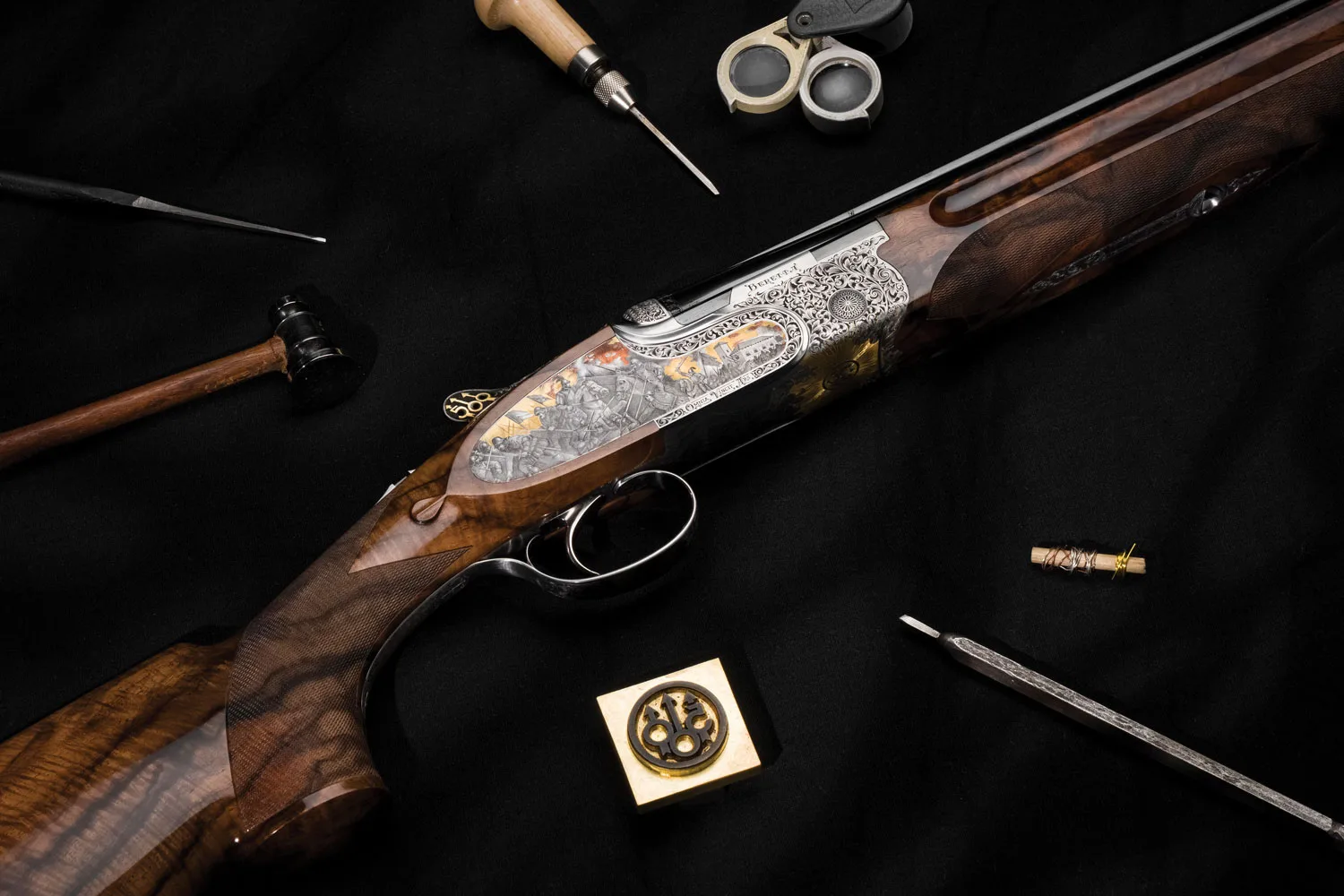
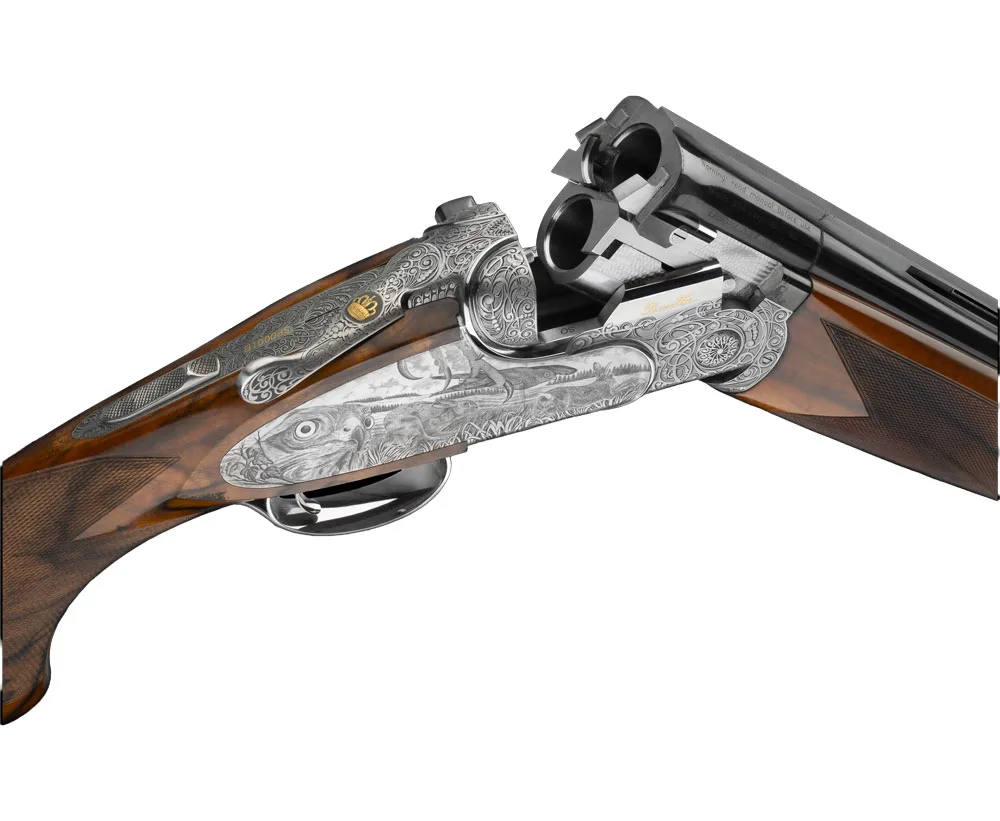
This year Beretta is celebrating its 500th anniversary with a one-off SO10 EELL engraved on the theme of the Battle of Pavia. Fought in 1525 between the Kingdom of France and the Habsburg Empire on the plains of Lombardy, it was one of the most pivotal clashes of the high Renaissance. Its significance for Beretta is that it was one of the earliest battles in which handheld firearms played a decisive role and that at least some of the arquebus barrels involved were products of Beretta antecedents.
In a press release announcing the gun, company President & CEO Franco Gussalli Beretta said, “We’re in 1525, one year before the famous Bartolomeo Beretta’s receipt that allowed us to date Beretta origins around 1526, and we’re in Pavia, Lombardy, quite close from Bartolomeo’s workshop . . . . The Val Trompia was already a reputed and designated center for barrel manufacturing at that time—and chances arquebus barrels produced by Bartolomeo Beretta took part in the battle are extremely high.”
One thousand hours of engraving depict Spanish arquebuses (on the SO10’s left lockplate) decimating the French cavalry (right lockplate), while the underside of the action features a scene of Charles de Lannoy, Viceroy of Naples, kneeling before the vanquished French King Francis and kissing his hand as a sign of respect before taking his sword. The gun perfectly illustrates Beretta’s legacy of Renaissance-era craftsmanship married to 21st Century technology, combining indestructible construction with postmodern luxury.
This 500-year-old company has acquired the same aura of sprezzatura as the makers of those bright-red motorcars from Modena. The word “iconic” is done to death, but the SO10 Beretta demands it.
Special thanks to Bruno G. Rüttimann, whose book, The Beretta SO Over-and-Under—Collector’s Guide for Models of 1934–1987, provided much of the information for this article.
Doug Tate
Read our Newsletter
Stay connected to the best of wingshooting & fine guns with additional free content, special offers and promotions.


