From our January/February 2026 Issue
Driving southeast from Tucson, I couldn’t help but sense the spirits of the Old West. First I passed a sign for Tombstone, evoking thoughts of Wyatt Earp and the O.K. Corral. Then there was the turn-off for Cochise Stronghold, bringing to mind the Apache chief and the brutal Indian Wars. After leaving the town of Sunizona, I turned off the pavement onto dirt, and several miles later came across a marker for Johnny Ringo’s grave. I could almost hear Doc Holiday: “I’m your huckleberry.”
The road continued into the foothills of the Chiricahua Mountains, and eventually I drove through an open metal gate, past a barn and corrals, and arrived at my destination: El Coronado Ranch. You see, I hadn’t traveled halfway across the country to relive the past or right any old wrongs. I was there on a much more important quest: to take quail species I’d never hunted in an area I’d only read about.
The idea for an Arizona hunt had been percolating for some time. I didn’t grow up a quail hunter, but once I got a taste for chasing the little buzzbombs, I was hooked. Over time I’d been lucky enough to take bobwhites in the Southeast, valley quail in Argentina and scaled quail in Colorado, but I had never made it to the Southwest to try for scaled, Gambel’s and Mearns quail. When I finally decided to make the trip, I contacted my old friend Dave Brown, who owns Dave Brown Outfitters and runs hunts out of Patagonia, Arizona, and the El Coronado Ranch, in the state’s southeast corner. Twenty years earlier I’d hunted Hungarian partridge with Dave in Saskatchewan and knew he was a hardcore wild-bird man with first-class dogs. He happened to have an end-of-season opening at El Coronado, so I booked the trip.
When I arrived late last January, conditions were not ideal. It wasn’t that quail numbers were poor but that the area hadn’t received rain since October, and the heat and dryness were making scenting tough for the dogs. Dave knew that the birds were there; it was finding them that was the challenge.
The other challenge was that Arizona’s three quail species occupy different habitats—scaled and Gambel’s quail, considered “desert quail,” preferring lower, flatter areas, and Mearns occupying the higher elevations of the foothills. Bagging at least one of each species—known as taking the “Arizona quail slam”—might prove especially difficult . . . .
But if there were any place in the state to up one’s odds of success, it was the El Coronado. Not only does hunting out of the ranch provide access to about 150,000 acres of deeded and leased land, but also a portion of the property has been actively managed for wildlife—quail in particular. Dave is the sole outfitter operating out of the lodge, and he runs only six to eight three-day hunts per season with a maximum of 10 hunters at a time. In other words, the grounds see very little pressure.

The lodge itself, which overlooks a lake, was built in 1924 and completely refurbished in 1999. It is a traditional plantation-style structure featuring 12 bedrooms and 12 baths along with a great room with an oversized fireplace, a bar area, a library with a billiard table, and a large dining room.
But it is the land surrounding the lodge that is fascinating in terms of its history and features. Located in the Turkey Creek watershed on the west side of the Chiricahua Mountains, El Coronado Ranch sits adjacent to the Coronado National Forest and the Chiricahua Wilderness Area. In the mid-1980s the ranch was purchased by Josiah Austin and his then wife, Valer Clark, as part of a greater effort to protect, restore and promote biodiversity on a number of borderland properties in the US and Mexico. Like many of the properties the couple brought, the El Coronado had been overgrazed, resulting in soil erosion and damage to vegetation. To remedy that damage, the couple had embarked on a Herculean project to manage water resources, eradicate invasive species and reintroduce native species.
Water-management efforts focused primarily on building trincheras and gabions—earthen and stone “dikes” placed in arroyos and washes to slow the passage of rainwater. The goal was to retain water and erosive soils, which would enable vegetation and animals to regenerate by providing moisture and food. And it worked.
Over the course of 30-plus years, a guesstimated 30,000 of the berms were built on the El Coronado alone—and wildlife flourished. The results were significant enough to earn the couple a number of state and national conservation awards.

Austin, a wingshooter, viewed many of the efforts through the lens of how they would benefit quail—especially Mearns. After all, the silt retained behind the trincheras would promote the growth of native grasses and sedges, the bulbs of which Mearns feed on.
Eventually the owners were looking for a way to offset some of the costs of the work, so they approached Dave about facilitating hunts. Today quail hunting is the only type of commercial hunting allowed on the property.
In 2021 the El Coonado was sold again—thankfully to another quail hunter. Habitat work continued, and there was a big push to make the ranch’s cattle operation and quail hunting complement one another. The focus continued to be on water but pivoted to water tanks. The thinking was that the more water tanks there were, the more the cattle would spread out and not overgraze the land. Having the water tanks remain full, especially during the dry season, would also increase the survivability of quail, allowing them to carry over to the next nesting season.
The efforts have been working well so far.
The morning after I arrived, we enjoyed a big breakfast, and then Dave and I and James Thornburg, another guide, drove from the foothills into the valley. The plan was to first try for desert quail—scalies and Gambel’s—and, if we were lucky, move back to higher ground for Mearns.
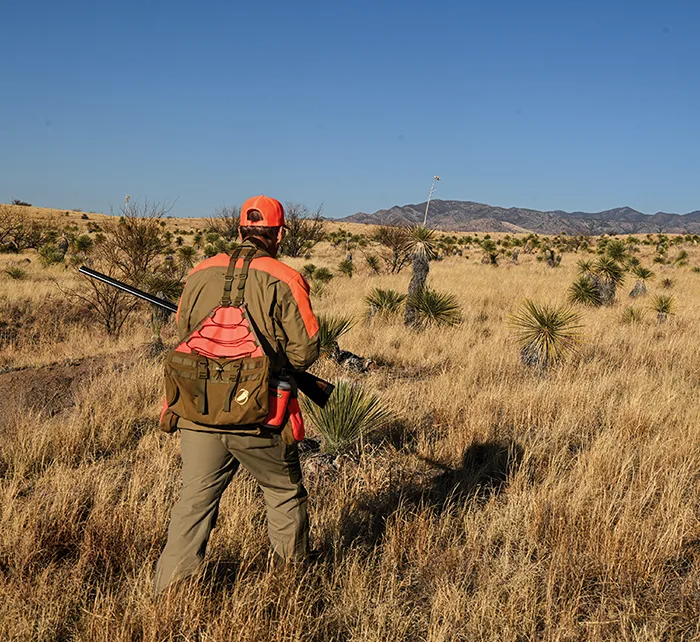
The ranch we started on was a 40-minute drive from the lodge and about 40 miles north of the Mexican border. It was beautiful country: a sea of patchy grass and brush stretching to a horizon rimmed with mountains.
Dave had brought a trailer full of dog power, including several pointers and Brittanys, a Lab and a pair of young pointer-Brittany crosses he jokingly referred to as “Anglo-Breton shorthair pointers.” He put two Brittanys and two pointers on the ground, and we set off.
My initial impression that the terrain was flat quickly proved wrong, as there were numerous brush-choked washes and arroyos to traverse. Dave, a former paratrooper, was unfazed, and continued at a steady march. I now understood why he had suggested getting in shape prior to the hunt.

We were a half-hour from the trucks when a large covey of Gambel’s quail flushed wild near a water tank and spread out in a bowl. One of the pointers locked up, and a single broke to the right and uphill. The Charles Lancaster 20-gauge Dave had lent me came up easily, and I rolled my first Gambel’s quail into the grass. It turned out to be a beautiful hen.
Several other birds jumped wild, so we climbed the small ridge looking for the rest of the covey. Right at the crest, a bird flushed to my left and flew directly in front of James, so I couldn’t shoot. But then another got up almost at my feet and rocketed downhill. I was able to bounce what turned out to be another hen into a draw.
We returned to the trucks for fresh dogs and water, and then embarked on another long walk. Just as we’d come full circle, one of the Brittanys went on point and a half-dozen Gambel’s flushed. I missed a bird twice going away and as I was reloading, a beautiful male flew directly overhead. Dave marked him down, and when we approached the spot, the bird got up and streaked left. My first shot dropped a leg and my second drew feathers. James watched the quail fly about 100 yards and thought he saw it go down after passing over the trucks.
When we got back to the vehicles, we let out a pack of dogs for a dead-bird search, and in short order Dave’s black Lab, Molly, came prancing back with a handsome male Gambel’s. I took a few minutes to admire the bird, with its black face and throat, rust-colored “cap” and prominent black topknot. Mother Nature had done well.
Relaxing in the shade of the trucks, we enjoyed a nice field lunch while gazing out at the surrounding mountain ranges: the Chiricahuas to the east, the Swisshelms to the south and the Dragoons in the distant northwest. It was hard to not think about all the conflicts that had played out in that rough country—and all the blood that had been spilled . . . .
After lunch we headed to another ranch where Dave said the cover was a bit more open and better for scaled quail. The cover was a bit more open and better for scaled quail. By the time we arrived, however, it was close to 4 PM and the temperature was nearing 80. The wind had picked up, too, making scenting conditions even tougher.
We had made a fast-paced loop through the grass and, though the dogs acted birdy several times, never found a covey. We took it as a sign to return to the ranch for cocktails.
The next morning we traveled to a different ranch where Dave hoped we might find some scalies. It turned out his hunch was right, as just after we passed through the gate, we spotted a covey of about 20 crossing a berm.
James and I jumped out and grabbed a couple of dogs, and the chase was on. Literally. By the time we got to the top of the berm, only a couple of stragglers remained—and once they saw us, they turned on the afterburners. Striding as fast as I could, I occasionally would see a quail skittering through the brush, but by the time I’d rush to the spot, the bird would have vanished. It was like chasing ghosts.
After a couple hundred yards we gave up and turned back. The dogs had never bothered pointing.
Farther into the ranch we set off on an “official” hunt—heading across a grass flat toward a distant lone oak. While working up a draw so full of carclaw and tumbleweeds that we could barely navigate through, Midge, one of the Anglo-Bretons, went on point. As I waded over, a covey of about 60 Gambel’s blew out of the tumbleweeds. I dropped one, missed a second and, as I fumbled to reload, a holdout flushed and flew directly overhead. Figures.
We circled back to the trucks, and then drove to a water tank near where Dave had found a covey of scaled quail several weeks prior. A wide wash led away from the tank, and we made our way along the edge of it, letting the dogs crisscross the bottom. As we neared the spot where Dave had marked the covey, a couple of quail flushed wild. We hurried forward, and another bird got up within range, flying left to right. I whiffed twice. I reloaded just as a fourth bird got up, but it remained low in the wash and I held fire because of the dogs.
Suddenly Dave yelled, “Behind you!” and I turned to see one of his Brittanys, Honey Badger, on point five feet away. I stepped in the dog’s direction, and a bird flushed straightaway, making for an easy shot. And just like that I had my first scaled quail—a healthy adult with grayish, scale-like chest feathers and a buff-colored crest on its head.
We continued the loop and returned to the trucks, where we indulged in Mexican Cokes—with real sugar.
Now that I had two of the three species of the slam, Dave asked if I wanted to go to some Mearns-looking habitat nearby ot to an area he said was a “sure thing.” I opted for the latter. So we drove back to the El Coronado Ranch proper and into the Chiricahua foothills.
After scarfing down lunch, we headed into the hills. The terrain, which was gently rolling but rocky, was blanketed with tall grass and sprinkled with oak trees. Dry washes and streambeds veined the land, and occasionally we’d come across a trinchera and marvel at how it was serving to retain silt. Sure enough, in many of the silt deposits were telltale scratch marks where long-toed Mearns quail had been digging for tubers.
We’d been walking for 20 minutes when the dogs began getting birdy near a couple of oaks. Chili, a pointer, locked up, and her Brittany bracemate, Jimmy, slid in to back. As I stepped out front, a bird flushed uphill and I tumbled it in a puff of feathers.
The quail Chili retrieved was one of the most beautiful birds I'd ever seen. The mature male had circuitous black stripes on his white face, a bluish bill and a “vest” of white polka dots framing a brown chest. With such a flamboyant getup, it was easy to understand why Mearns are sometimes called Montezuma and even clown quail.
On our way back to the trucks, several other Mearns got up wild—evidently from a scattered covey. Dave asked if I wanted to keep hunting, but I told him my day was complete. Besides, it was time to celebrate my “quail slam” with ice-cold Modelos.

On the third and final day, I said that I’d like to spend more time in Mearns country, so we explored some pine-studded valleys near the lodge. Trincheras were seemingly everywhere, and we got to see some of the wire-caged gabions in the larger watercourses. It was hard to imagine all of the work that had gone into building the structures, but the efforts were obviously paying off. Mearns sign was plentiful, and we found several healthy coveys.
Driving back to Tucson, I thought about how successful my quest had been. I’d gotten to explore new country, hunt with great people and dogs, and check a couple of quail species off my “life list.” As a bonus, I’d witnessed how human ingenuity—even something as simple as stacking rocks in a creek bed, can influence and improve wildlife habitat. The trip had checked all the boxes in terms of what a wingshooting adventure should be.
For more information on the El Coronado Ranch, visit davebrownoutfitters.com.
Read our Newsletter
Stay connected to the best of wingshooting & fine guns with additional free content, special offers and promotions.