
From our November/December 2026 issue
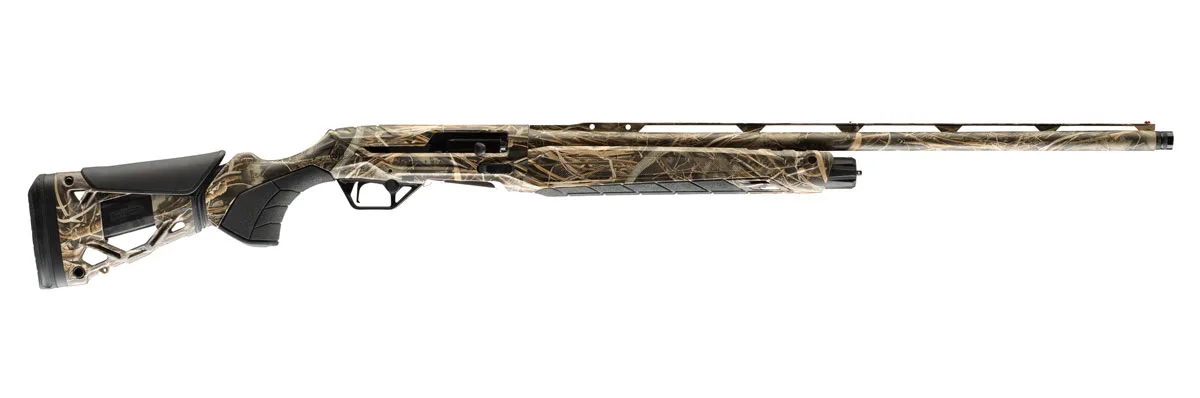
Beretta has always been long on innovation. The company’s 500th-anniversary tag line is “Legacy Forges Tomorrow.” With the AX800 Suprema 12-gauge waterfowl gun, tomorrow can be had today for $2,599. I normally wax poetic about nimble, artistic side-by-sides and stack-barrels, but I averted my gaze from such guns to this tricked-out semi-automatic with a camouflaged polymer stock, oversized controls, adjustable and textured everything, and scads of branding. The AX800 is a high-tech, soft-shooting, fast-cycling, easily manipulated duck slayer, and I am in love with a plastic gun.
Beretta’s gas-operated autoloaders began in 1956 with the Model 60. Since then the company has produced scores of field, sporting and tactical gas guns. Frankly, discussing the greatest Beretta autoloader is as tedious as an MJ-Kobe-LeBron debate, but standouts are the AL391 Urika and Teknys and the entire A400 series. Now Beretta has delivered the AX800: its “most advanced waterfowl shotgun” ever.
Our AX800 had a 28" Steelium Pro barrel (26" and 30" barrels are available). Steelium Pro barrels are borrowed from Beretta’s DT11 sporting lineup. The nickel-chromoly steel is deep drilled, cold hammer forged, vacuum stress relieved and chrome lined. The barrel features a 17¾" forcing cone and offers promises of less muzzle rise, softer recoil and better patterns. The forcing cone leads to a 7½" overbored section of .732" (nominal is .729") and finishes with a 2¾" choke.
The extended Optima HP chokes (Cylinder, Improved Cylinder, Modified, Improved Modified and Full) are steel safe through Modified and measured +/- one-thousandth of nominal. A ¾" section extends from the muzzle. It is knurled with wrench cut-outs and designated with letters and stars noting constriction. The shaft calls out bore and choke size and steel-safe designation. The chokes threaded easily but backed out after lots of targets. So check the chokes in the blind while waiting for that next flight of mallards. Beretta’s plastic choke wrench is guaranteed to strip in short order. Buy a proper steel replacement wrench.
The barrel had a hydro-dipped Realtree Max-7 matte camo finish, to eliminate barrel glint from circumspect ducks or turkeys. (The gun comes in five other camo finishes as well as black.) I cannot speak to the finish’s durability, but what I’ve seen on older Berettas has held up. The rib jointures were disguised by the dip, but I am confident they were good. The 8mm parallel medium rib ramps up from the receiver. The top is machine crosshatched with a silver mid-bead and Lilliputian red front sight. I thought the front sight should have been larger, as such things do not annoy me on fowling pieces. A solid portion near the receiver sports three holes to accommodate a rail and barrel-mounted optics. The 5½" polished barrel extension incorporates a spring-loaded ejector. The machining for the ejector and cutouts for the bolt-cam extensions was exceptional.
The B-LINK Pro gas system extends from the barrel’s underlug. Gas outlets inside the barrel feed a circular manifold in the collar that evenly distributes the gas over eight exhaust ports to cycle the piston and action, reduce drag and increase efficiency. It is allegedly 36% faster than any other Beretta gas system. I had no way to prove this, but I know it cycled quickly. The machining and tolerances for the gas collar, spring and piston were superb. Their smooth PVD-coated steel reduces friction and debris. Beretta states the system is 46% cleaner than its other gas systems. Again, I can’t confirm the percentage, but I can say the gun cleaned easily after several hundred rounds. Of course, believing any gas system’s promise to run cleaner is done at one’s own peril . . . .
All plastics are polymers, but not all polymers are plastics. The AX800’s forearm and stock are plastic, while the receiver is polymer. Having not taken a chemistry class since 1982, I think of it all as plastic. And any surface on the AX800 that could be camouflaged, black-accented, textured, rubberized, oversized, logoed or branded has been.
The angular skeletonized stock has lots of indentations and recesses. The Kick-Off Pro recoil-reduction system’s guts run through the middle in a black plastic housing. According to Beretta, this system cuts felt recoil by up to 70% and is “designed for heavy-load waterfowl and sport shooting.” In addition, “Dual hydraulic dampers absorb shock, stabilizing the shotgun and enabling faster, more accurate follow-up shots.” I cannot attest to a 70% reduction, but I can say the gun was soft-shooting.
Factory specs were: 14½" length of pull, ⅛" drop at comb, 2⅛" drop at heel, ⅛" cast-off and 4° of pitch. A ½" spacer was backed with a spongy Buffer Recoil Pad. The angled heel is a nice touch to reduce snags on waterfowl clothing. Beretta maintains that the pad resists degradation from harsh waterfowl environments. I see janky pads on well-used A-400s, so let’s hope the company is right. The geometry was agreeable around the textured black rubber pistol grip, and my face felt comfortable against the black textured cheekpiece. The stock is also ripe for tinkering. The gun ships with an additional 1" spacer to adjust LOP. Three black plastic bushes are included to adjust cast and drop. The Beretta website offers a taller cheek pad and an oversized grip. Making adjustments and fine-tuning is not my bag. I prefer guns “right out of the box.” However, the owner’s manual and outstanding Beretta video support will take an adventurous owner through all the steps. With a Torx wrench, screwdriver, good Wi-Fi and patience, the fussiest shooter will be satisfied.
SNAPSHOT
Make & Model: Beretta AX800 Suprema
Gauge: 12
Action: Polymer semi-automatic
Chambering: 3½"
Finish: Realtree Max-7 camo (six camo options and black)
Barrel Length: 28" (26" and 30" available)
Weight: 7¾ pounds
Chokes: Optima HP extended (C, IC, M, IM, F)
Stock: 14½" LOP, 1/8" DAC, 21/8" DAH, 1/8" cast-off, 4° pitch (fully adjustable with accessories)
Accessories: Cardboard box, chokes, wrench, oil, bushes, sling attachments, owner’s manual
Price as tested: $2,599
The wide, deep forend filled my hand and provided a secure grip. The underside’s textured black rubber mimics that of the stock grip. The top sides’ molded checkering and sharp points will anchor the wettest hands or gloves. The forend secures to the magazine tube with the B-LOK system, which features a heavy plastic barrel nut/magazine cap with a neon-green accent, to help locate it if it goes astray. A stout steel bar inside the cap mates with a steel receptor at the end of the magazine tube. A quarter-turn releases it or locks it in place, and it stays put! Ease of use on a mission-critical part is always a plus.
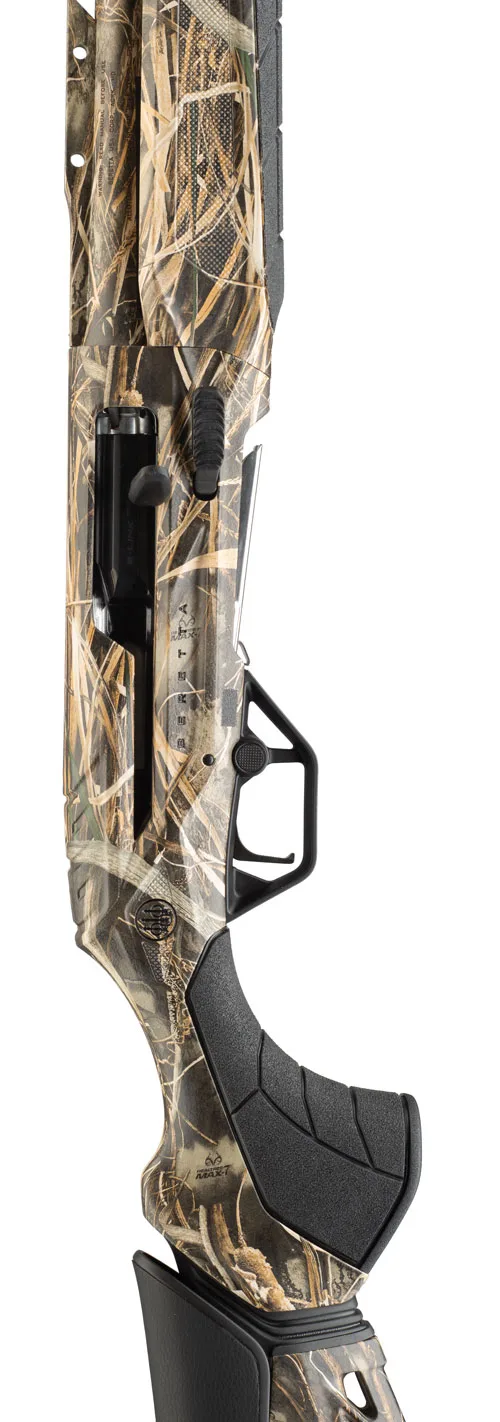
The receiver is made of Beretta’s NATO-tested and durable ARX polymer, used on military arms. It calls out the brand with its clever “AX800 Suprema” logo, featuring an integrated duck profile, and is ready to receive custom options. The top is drilled and tapped for optics mounting plates. I am not an optics guy, so I direct those interested to the Beretta website for details.
The blued-steel bolt housing is welded to steel guide bars and a steel collar. These mate with a plastic operating sleeve over the magazine tube and return spring. The polished white steel bolt was well machined and contains the firing pin and a stout blued-steel, spring-loaded claw extractor. With the bolt assembly retracted, the barrel extension inserted precisely into the front of the receiver with no wobble or play. Nothing felt cheap here. When the gun is in battery, cam extensions on the rotating bolt’s face lock into cutouts in the barrel breech. The bolt features an oversized grippy black charging handle. The cavernous ejection port accommodates 3½" empties, which expelled to the neighboring county during test-firing.
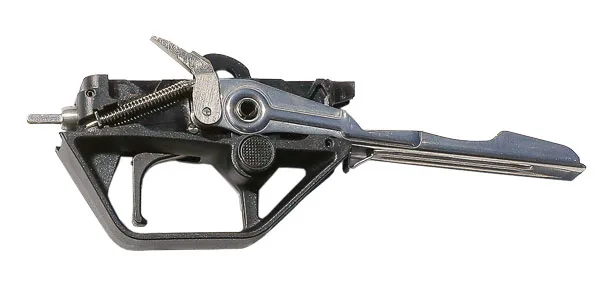
A rugged black plastic platform contains the trigger assembly, fire-control group, safety and Pro Lifter. It is secured with a single cross pin, and removal and insertion is easy. The bottom of the platform forms the oversized trigger guard, which allows gloved fingers to easily access the flat steel trigger blade. On top there is a spring-loaded hammer guide, hammer and integrated sear as well as the spring-loaded Pro Lifter. The steel stamped and forged parts are securely arranged with no shimmy or slack. It is all standard Beretta, which is a good thing. The 3½-pound trigger pull was superb, with no creep or take-up. The oversized, textured safety operated with ease. The hulking bolt release near the front edge of the ejection port was cobra-strike quick. The slightest touch hurtled the bolt forward. So watch those fingers!
This past May, with duck season months away, I tested the AX800 on clays at Orvis Sandanona. The first thing I noticed was that when the gun was fully assembled, all of the parts fit securely and there was none of the clatter or slop I’ve seen in some other semi-autos. The gun weighed 7¾ pounds and balanced just in front of the barrel/receiver intersection. It felt a bit barrel heavy—and even more so when loaded to its 2+1 capacity. Nevertheless, it did not feel cumbersome or unmanageable. The gun mounted and swung as if it were lighter. Using Kent Fasteel 2.0 2¾" 11⁄16-oz loads of No. 4 shot at 1,550 fps, the gun patterned 50/50 with the Modified choke.
The Pro Lifter and wide aperture at the bottom of the receiver made loading a cinch. Beretta explains that the lifter remains raised when the bolt is closed, which affords “unprecedented speed and ease of loading” and eliminates the risk of “thumb bite.” I concur. The Pro Lifter is the real deal.
The controls were easily accessible, and the oversized bolt handle, bolt release and safety all performed exactly as advertised. The same was true for the gaping trigger guard.
With the Kent Fasteel and two boxes of Fiocchi Flyway Steel 3" 1⅛-oz No. 2s at 1,500 fps, the Kick-Off Pro system devoured recoil, and shooting hot loads was just plain soft. This allowed me to stay in the gun for follow-up shots. Additionally, the gas system ran flawlessly for hundreds of rounds without a cleaning.
To be clear, I am not a 3½"-shell guy, but seeing as these shells are welcomed in plenty of boats and blinds, we busted out some Federal Black Cloud FS Steel 3½" 1½-oz No. 2s at 1,550 fps. Firing them was KISS-concert loud and, despite the Kick-Off, the recoil was emphatic! My peers agreed.
Beretta promises the B-LINK system allows the AX800 to cycle ⅞-oz target loads. That did not prove true with our gun. It would not cycle Winchester 1-oz loads at 1,180 fps and similar target loads. It even hiccupped with a 1,280-fps 1-oz field load. After a longer break-in period and a season shooting hot loads, the gun might have begun cycling lighter loads reliably. That is for others to find out.
Over the course of many rounds, the AX800 proved to be a lot of fun. The factory setup fit all five of the shooters who joined me. The gun was pointable and responsive. Several shooters praised the ideal handling and how easily the gun moved through challenging true pairs. We all noted that it shot right where it was pointed and annihilated clays. Personally, I liked how easily I was able to manipulate it target to target on crossing pairs. I did not break both clays every time, but the gun sure moved well.
Plenty of wood-and-steel pumpguns are still being shucked in duck blinds. But these days semi-autos dominate with waterfowlers. There are certainly more affordable autoloaders from other companies as well as guns within the Beretta family that serve the same function. But a compelling case can be made to acquire the AX800 as your next waterfowl gun or wild turkey thumper. It features a lot of innovative tech that works, it is adaptable to myriad shooter preferences, it runs like a Timex and, if it gets dropped in the mud, you can hose it off and keep on shooting. What more could a waterfowler ask for?
For more information, visit beretta.com.
Read our Newsletter
Stay connected to the best of wingshooting & fine guns with additional free content, special offers and promotions.