

From our July/August 2026 issue
On October 3, Fabbrica d'Armi Pietro Beretta will take a very deep breath and blow out 500 candles. In 2026, Beretta turns exactly twice as old as the United States. Even more remarkable, Beretta remains in the hands of the Beretta family in an unbroken line of succession extending 15 generations. Under the family's guidance, the company has grown to become a worldwide giant involved in every aspect of the shooting sports, as well as in law enforcement and military small arms and ammunition.
Beretta has promised to mark its birthday with 10 one-off and several limited-edition guns that will no doubt be spectacular. And while we wait for the company to unveil them, we have time to look back through the centuries at the history of the world's oldest gunmaker, to see how it grew to global prominence.
Italy's Val Trompia, in the foothills of the Alps, supplied iron for Rome's legions and remained an important ironworking center throughout the pre-firearms era. The valley's iron ore was of high quality, the Mella River running along the valley floor supplied water power, and the timbered slopes of the narrow valley provided wood to stoke the furnaces. The first known record of gunmaking in the valley dates to 1459, when the Venetian senate placed an order to the Rectors of Brescia for bombards, wall guns, rampart guns, handheld guns and iron-tipped crossbow quarrels.
At some point, members of the Beretta family started working as barrelmakers, likely prior to the "official" founding date of 1526. However, the Beretta paper trail begins exactly 500 years ago when the Venetian senate ordered 185 arquebus barrels from Maestro di Canne ("master gun-barrel maker") Bartolomeo Beretta of Gardone. That barrel invoice—Beretta's "birth certificate"—survives with the date October 3, 1526, scrawled across the top.
Bartolomeo's son, Jacomo, became a maestro di canne, as did his grandsons, Giovannino and Lodovico, as Val Trompia grew into a major manufacturing hub for weapons and tools. By the mid-16th century, some 50 mines and numerous smithies and smelters were turning ore into iron in the valley. Giovannino and Lodovico's sons and grandsons became maestros. The Berettas supplied arms to the Republic of Venice for more than 2½ centuries.
The family's long association with Venice ended when the Republic fell to Napoleon, in 1797, but the Berettas were able to pivot and sell barrels to the French Army until its defeat at Waterloo ended the Napoleonic Wars, in 1815. The Berettas then began selling to Austria. Still, the subsequent peace after 1815 was bad for business. Barrelmaking was a specialized skill, and the Berettas struggled in the comparatively quiet decades following the Napoleonic Wars.
Pietro Antonio Beretta was the 10th generation of Berettas. Born in 1791, Pietro understood the need to diversify into civilian and sporting-arms sales, and through the first half of the 19th century he worked to build a network of dealers and retailers. In 1832 he gave the company his name: Fabbrica d'Armi Pietro Beretta ("Arms Factory Pietro Beretta").
Pietro's son, Giuseppe, continued his father's work while also turning a company best known for supplying barrels into a maker of completed guns. By the 1880s, Beretta had increased its production of shotguns from a few hundred a year to 8,000 annually and earned a strong reputation as a maker of sporting guns. Mindful of the need to display its wares, Beretta built a showroom in the 1880s, and today it houses the private Beretta museum next to the Beretta villa.
Upon Giuseppe's death, in 1903, another Pietro Beretta took over the company. This Pietro would lead Beretta until 1957. He oversaw massive expansion, including the introduction of modern industrial production, and proposed the establishment of an Italian proof house in Gardone to help Italian manufacturers compete with makers from other European countries. The proof house was established in 1910, with Beretta the first company to register a proof mark.
Beretta was already well known as a maker of side-by-side shotguns when Pietro began working with a talented gun designer, Tullio Marengoni, on an over/under. Despite being neither hunter, target shooter nor even a trained engineer, Marengoni—who already had the 1915 pistol and 1918 carbine to his credit—created one of the world's finest shotguns in the 1930s. The S.O.1., later named the SO for Sovrapposto ("Superposed"), first appeared in the Beretta catalog in 1934. The SO, along with the post-WWII 680 O/Us and 300-series semi-autos, would help establish Beretta as a world leader in sporting and hunting shotguns.
With the name Sovrapposto, it's obvious that Marengoni had John Browning's last invention in mind when he designed his gun. Marengoni and others at Beretta condemned the Browning as "high, heavy and ugly," while the Sovrapposto was trim and elegant—and much more expensive than a Superposed. WWII interrupted SO production, as Beretta switched back to military guns and endured Allied bombing raids by moving machinery into tunnels in the valley walls. Pietro was arrested by the Germans at the war's end, and then freed by Italian partisans in a gun battle.
After the war, production of SO guns resumed. The SO made big news in 1956 when Italian shooter Galliano Rossini won a gold medal at the Melbourne Olympics with an SO3 EELL. Rossini's feat burnished the SO's reputation, and his gold would be the first of many Olympic medals won with a Beretta target gun.
In the mid-1950s, Beretta introduced the S series of O/Us, starting with the S55. Unlike the handmade SO sidelocks, the affordable S-series guns had interchangeable parts that could be blued prior to assembly and required little fitting, making them ideal for mass production. S-series guns were extremely durable boxlocks with low, sleek profiles that made them natural pointers. They would evolve into 680- and 690-series guns and become hugely popular around the world.
Likewise, Beretta's first gas semi-automatic, the Model 60, was designed in the mid-1950s, and it was the beginning of a line that would include the 300, 303, 390, 391 and eventually the A400. Beretta semi-autos have come to represent the gold standard of gas guns. They are not only popular in the uplands and in duck blinds, but they are also virtually the only semi-autos seen in serious clays competitions.
Despite the strides in shotgun design and marketing Beretta was making in the 1960s, the company made a brief stab at diversifying outside the gunmaking business. As a hedge against anti-hunting and anti-gun sentiment, Beretta partnered with Britain's Cam Gears Company to open a plant in Gardone building steering units for cars. Both Beretta and its partner eventually sold out to TMW, another maker of steering units, and Beretta went back to making guns.
In 1977, Ugo Gussalli Beretta, the 14th generation of Beretta leadership, oversaw the formation of Beretta USA as the company made its "great leap" into the important U.S. market. In the 1980s, the company moved some production to a new factory in Tennessee—first for the Model 92S pistol made under contract for the U.S. military. Also under Ugo's guidance, Beretta acquired Benelli in 1983 and Franchi in 1994.
Incidentally, it was during the 1980s, as Beretta was making large strides into the U.S. market, that General Motors decided "Beretta" would make a cool name for a car. Without asking permission, GM introduced the Chevrolet Beretta. Beretta sued, and GM settled out of court with a $500,000 donation to Beretta's Foundation for Cancer Research and Treatment and an actual Chevy Beretta with the Beretta trident painted on the sides. (The car currently resides in the Gallatin, Tennessee, plant.) Another curiosity of the 1980s was a pair of Beretta-made Brownings: the BDA .380 pistol and the B-80 semi-auto—essentially a Beretta 302/303 with a humpback and a Buckmark. Those guns were the result of an alliance between Beretta and FN Herstal. The FN-Beretta partnership ended in the mid-1990s, just prior to the creation of Beretta Holding.
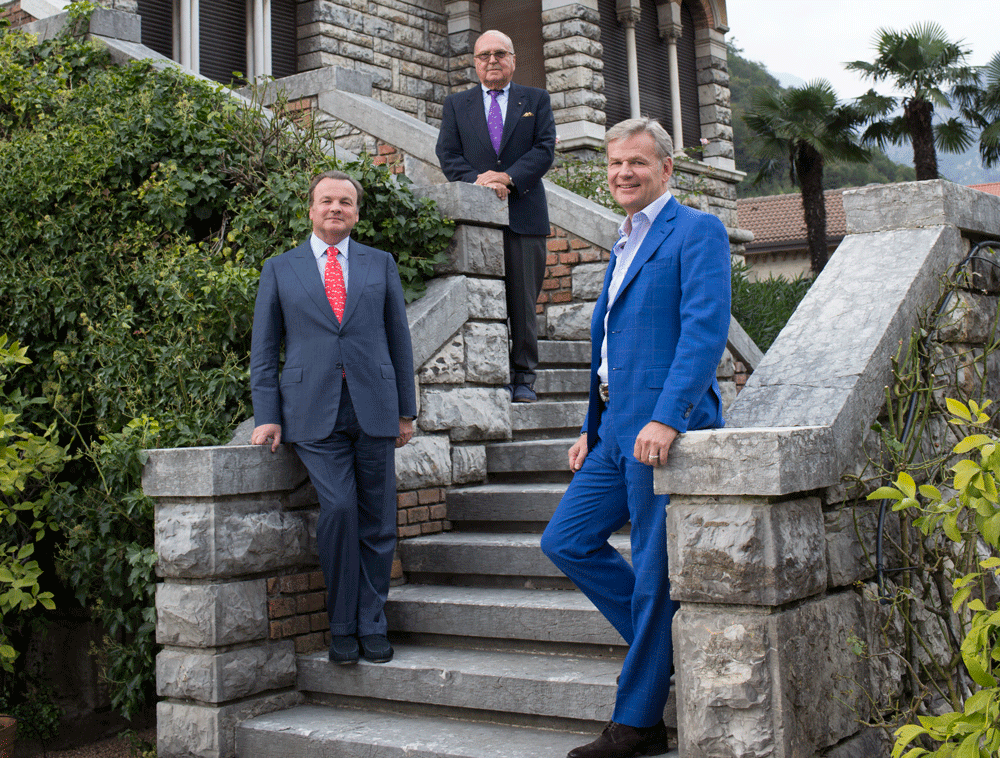
In 1995, Ugo's sons, Pietro and Franco—the 15th generation of Beretta family leadership—took over the company. Forming Beretta Holding, they began a series of acquisitions, including Finnish riflemakers Sako and Tikka, Old West replica specialist Uberti and Turkish gunmaker Stoeger in 2000; English gunmaker (and purveyor of luxury clothing and accessories) Holland & Holland in 2021; and French gunmaker Chapuis in 2019. In addition, Beretta acquired optics companies Burris (2002) and Steiner (2008), along with outdoor clothing brands.
In 2022, the acquisition of Switzerland's RUAG Ammotec brought ammunition brands such as RWS, Norma, Geco and Rottweil into Beretta Holding. Pietro Gussalli Beretta, President and CEO, via e-mail, called the move "a transformational step for Beretta Holding. It completed the Group's industrial ecosystem by adding a leading ammunition platform alongside firearms and optics. Strategically, it allows Beretta Holding to serve civilian, law enforcement and military customers with a fully integrated offering while strengthening technological capabilities, supply security and global manufacturing reach—particularly in Europe and the United States."
Five-hundred-year-long story short: In a half-millennium, Beretta grew from an artisanal shop making barrels into a holding company with a global portfolio encompassing every aspect of shooting. Beretta is now positioned as a maker of military small arms and reliable hunting guns, as well as a luxury brand, operating high-end Beretta Galleries in New York, Dallas, Paris and London, and Holland & Holland's gunrooms in London and Dallas and its Shooting Grounds in west London. The company isn't done growing, either.
In recent years, the defense portion of Beretta's revenues has increased as European militaries have rearmed, but the company has learned from its own history not to rely on a single segment of the market. According to Pietro: "Civilian and sporting activities remain the foundation of the Group, while law enforcement and defense business provides scale, stability and technological advancement."
This year's newest Beretta hunting gun, the AX800 semi-auto, exemplifies how technological advances in one segment—defense in this case—can carry over to sporting arms. In 2004, Beretta developed the rugged ARX 160 rifle for the Italian army. The innovative rifle featured an all-polymer frame. In 2026, Beretta used the lessons of the ARX 160 to make the AX800 autoloading shotgun. It, too, has an innovative all-polymer frame for weather resistance, stability, reliability and ease of maintenance.
But don't let the future-tactical looks of the AX800 mislead you. Beretta hasn't lost its ability to make guns look good, and there will be plenty of evidence of that during the 500th-year celebration. There will be one-of-a-kind works of gunmaking art unveiled later this year.
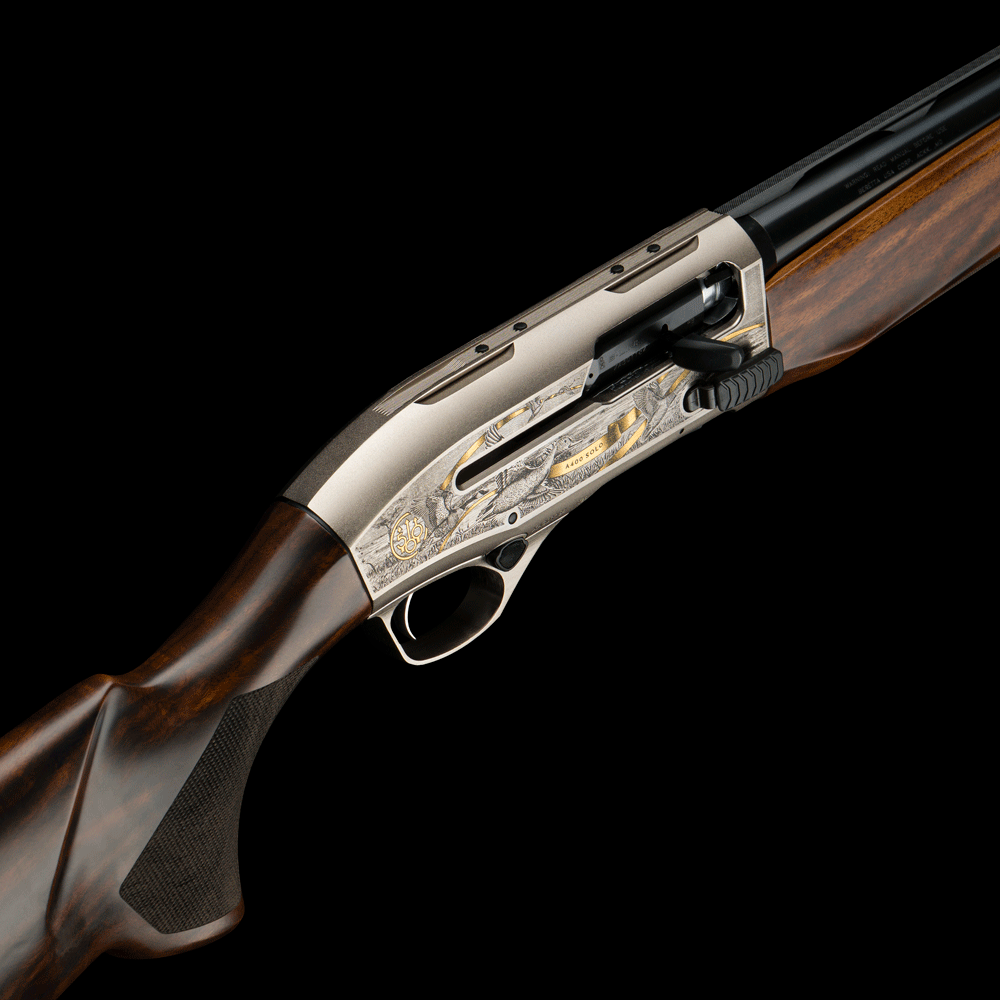
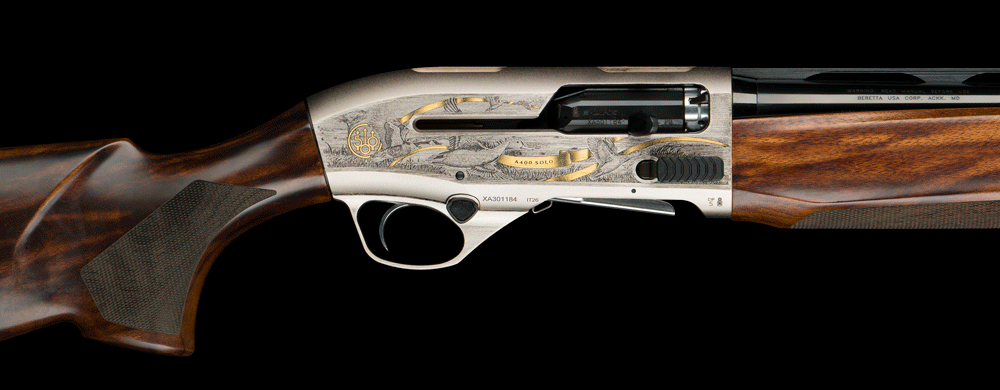
There will be limited editions too. The first of those is the A400 500 Years Special Edition. It has a nickel-silver receiver engraved with several upland gamebird species on one side and ducks and geese on the other. The engravings have ink accents and gold inlays. Pretty as it may be, I have a feeling it's just a warm-up for what we're going to see later.
Meanwhile, this year's buyers of new A400s, AX800s, 3901 Tacticals and all the 680s and 690s, as well the DT11, SL2 and SL3 O/Us, qualify for a free 500-year medallion. It bears the trident logo on one side and the Beretta villa on the other. Packed in a stylish box decorated with the trident logo and "1526," it's Beretta's gift to customers in this milestone year.
Beretta survived more than hundreds of years because the Beretta family understood when the company needed to change and grow. As Beretta moves into its next 500 years, Pietro Beretta said, "Beretta Holding operates with a multigenerational perspective. As a family-owned industrial group, its strategy is focused on long-term value creation rather than short-term optimization."
In other words, as we've seen, Beretta is in this for the long haul.
Beretta is often noted to be the oldest firearms manufacturer, which it is, and the oldest family-owned manufacturer of anything in the world, which it also is. It is also true that Japanese construction company Kongo Gumi remained in the ownership of the Kongo family from 578 to 2006—1,428 years. Beretta has a long way to go to exceed Kongo Gumi's long run, but it seems well-positioned to do so. While it is hard to imagine what our world may look like in 928 years, chances are good that if people are still shooting—and they probably will be—they will be shooting Berettas.
Read our Newsletter
Stay connected to the best of wingshooting & fine guns with additional free content, special offers and promotions.